Three ingredients. That's the whole plan, and I'll give it to you before the scroll: plenty of protein, a small calorie deficit, and lifting something heavy a few times a week.
Not keto. Not fasting windows. Not whatever arrives on your feed Tuesday with a countdown timer attached. Those are all just wrappers, some useful, some silly, around the same three-part engine, and the engine is the part that's been quietly working since before I was born. Diets have brands. Physiology doesn't.
I know that opening sells zero supplements. Tough. The rest of this piece is me earning it, what "fat loss and muscle gain at the same time" actually means and who gets to have it, the real numbers, where keto and fasting and the Mediterranean crowd fit, what a normal day of eating looks like, and the handful of mistakes that quietly strangle the whole project.
One thing said straight before any of that. General information here, not personal advice, I don't know your body or your history. Medical conditions, medications, pregnancy, or any past trouble with disordered eating, those all mean you build this with a professional instead of an article. Including this article.
Can You Really Do Both at Once?
Losing fat requires a calorie deficit. Building muscle prefers a surplus. So the internet's forever-war over whether "body recomposition" is possible makes sense on paper, and the practical answer is more useful than the war: yes, both at once is achievable, for some people much more easily than others.
Recomposition works best for beginners to strength training, whose muscles respond to almost any structured stimulus. For people returning after a long layoff, muscle memory is gloriously real. And for anyone carrying meaningful extra body fat, which the body happily spends as fuel for building while the scale drops. If you're in one of those groups, congratulations, this article's title describes your next six months.
If you're already lean and well-trained, the honest news is that simultaneous progress slows to a crawl, and most experienced lifters alternate phases instead, a stretch focused on building, a stretch focused on cutting. Still the same three ingredients, just with the calorie dial pointed differently. Either way, everything below applies.
Ingredient One: Protein, the Non-Negotiable
If this article were one sentence, it would be about protein. It's what preserves and builds muscle while fat comes off, it's the most filling thing you can eat, and it even costs your body extra calories to digest. Underrating protein is the single most common reason "eating less" turns into losing muscle instead of fat.
The evidence-based target most sports nutrition bodies converge on sits around 1.6 to 2.2 grams per kilogram of body weight daily, which for many adults lands somewhere between 100 and 180 grams. That's more than most people eat by a wide margin, and hitting it is genuinely the hardest habit change in this whole plan, so make it mechanical: a protein anchor at every meal. Eggs, chicken, fish, lean beef, Greek yogurt, paneer, cottage cheese, lentils and beans doing double duty, whey if whole food falls short on busy days. Spread it across three or four meals and the target takes care of itself.
Ingredient Two: A Small Deficit, Emphasis on Small
For fat loss with muscle gain, the deficit wants to be modest, in the neighborhood of 300 to 500 calories below maintenance, producing something like a quarter to three-quarters of a percent of body weight lost per week. Slower than the internet promises. Fast enough to transform a body in six months.
Why not slash harder and finish sooner? Because aggressive deficits are muscle-eaters. Cut too deep and the body starts burning the very tissue you're training to build, energy tanks, workouts decay, and the whole recomposition machine seizes. The irritating truth of this game is that patience is a mechanical requirement, not a virtue.
You don't necessarily need to count calories forever, but a short counting phase, even two weeks with a free app, teaches most people that their "roughly 2,000 calories" was roughly 2,800, and that education alone is worth the tedium. After that, many do fine with the plate method: protein anchor, half the plate vegetables and fruit, a fist of starch scaled to activity, fats riding along in cooking and whole foods.
And the liquid calories rule from every honest diet article ever written applies doubly here: sugary drinks and heavy pours are pure deficit-killers, hundreds of calories with zero fullness and zero protein.
So Where Do Keto, Fasting, and the Famous Diets Fit?
Here's the section the diet industry would rather I skip. Every branded diet that works, works the same way: it's a fence that helps a particular person eat less while keeping protein adequate.
Keto fences off carbs, which drops calories sharply for people whose extra calories came from carbs, and suits some appetites well; it does make fueling hard training harder, which matters for the muscle half of our project. Intermittent fasting fences off time, brilliant for people who overeat at night, rough for anyone who struggles to pack a day's protein into a short window, watch that carefully. The Mediterranean pattern is less a fence than a general upgrade, and it's the one with the deepest health evidence behind it, my default recommendation for anyone who hates rules. Paleo, carnivore, vegan approaches, same analysis every time: does it keep your calories controlled and your protein high, and can you happily live inside it for a year? Yes to all three and it's a fine vehicle. No to any and it's a countdown timer.
The best diet plan, in other words, is the one that fits your appetite, culture, and kitchen while delivering the two numbers that matter. The brand name is upholstery.
A Day of Eating, Sketched
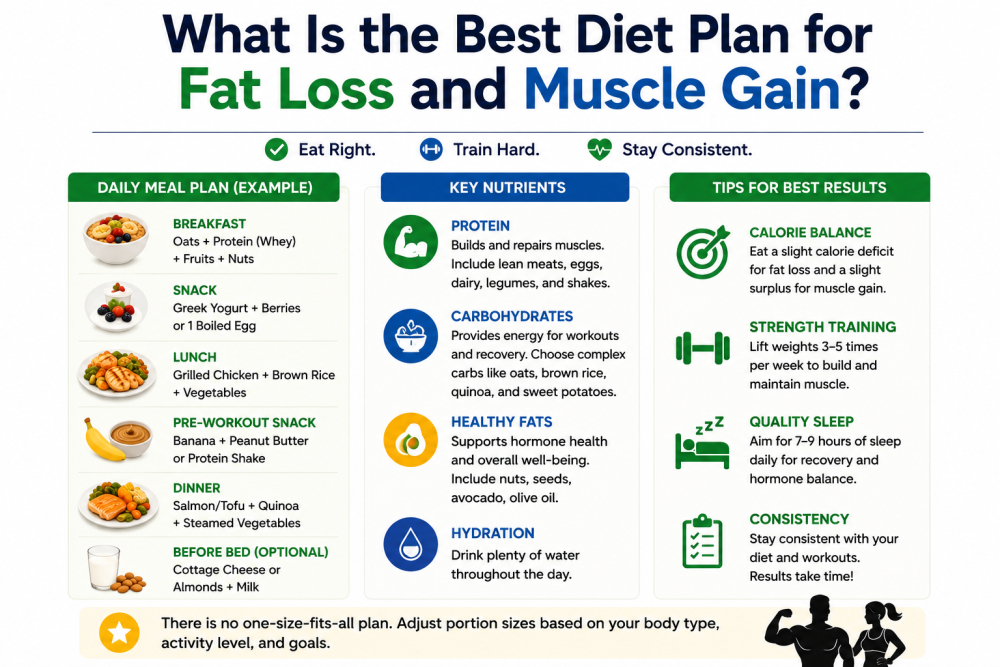
To make it concrete rather than theoretical, here's the shape of a day that hits the targets for a hypothetical average adult, adjust portions to your size and appetite.
Breakfast built on eggs or Greek yogurt with fruit and oats. Lunch around a big protein serving, chicken, fish, paneer, beans, over a pile of vegetables with rice or bread scaled to how active the day is. An afternoon anchor if the gap is long, yogurt, a protein shake, a handful of nuts with fruit. Dinner echoing lunch with different flavors so boredom doesn't win. Water or unsweetened drinks doing the hydrating. Nothing exotic, nothing branded, and critically, one or two meals a week that are purely for joy, eaten without arithmetic or apology, because the plan that never bends is the plan that eventually snaps.
The Part Diet Articles Underplay: You Still Have to Lift
No diet builds muscle. Diet permits muscle; training builds it. Two to four strength sessions a week, progressively harder over time, squats, presses, rows, hinges, pulls, whether that's barbells, dumbbells, machines, or well-programmed bodyweight work at home. Pair that with the protein and the gentle deficit and you've assembled the entire recomposition machine. Skip it and the same diet just makes you a smaller version of your current shape.
Sleep belongs in this section too, seven to nine hours, because muscle is repaired and hunger hormones are regulated overnight, and a sleep-deprived recomp is a car with two flat tires. It drives. Badly.
The Bottom Line
So, the plan. Protein, 1.6 to 2.2 grams per kilo, every day, no negotiating. A deficit of a few hundred calories, small enough that training still feels strong. Whatever eating pattern you can actually live inside, wrapped around those two numbers. Lifting, two to four times a week, getting gradually harder. Sleep doing the repair work at night.
Then the hard part, which isn't any of that. It's doing it in week nineteen, when the scale's been sulking for a while and someone at work just lost six kilos on some cabbage thing. Hold anyway. Measure with a tape and photos, not the scale's daily moods, give it six unglamorous months, and let the fad-of-the-week people lap you on speed while you beat them on still-being-here.
Slower than the ads promise. Sturdier than every fad that's died since I started paying attention. Good trade.
FAQs: Diet for Fat Loss and Muscle Gain
How much protein do I need to lose fat and gain muscle?
The range the sports nutrition bodies keep landing on is 1.6 to 2.2 grams per kilo of body weight daily, call it 100 to 180 grams for most adults. That's a lot more than most people eat, honestly, and the only way I've seen anyone hit it consistently is the boring way: a protein anchor at every single meal, three or four times a day.
Can I build muscle while eating in a calorie deficit?
Yes, with conditions attached. Small deficit, high protein, real training, and it works best if you're new to lifting, coming back from a long break, or carrying decent fat stores to draw from. Already lean and trained? Both-at-once slows to a crawl, and alternating build phases with cut phases gets you there faster.
Is keto or intermittent fasting better for fat loss?
Wrong question, and I mean that kindly, neither one is magic. Both are fences that help certain people eat less. Keto works if your problem calories were carbs, though it makes fueling hard training annoying. Fasting works if you're a night snacker, though cramming a day's protein into six hours is a genuine struggle. Pick the fence that matches your weakness, or skip fences entirely and just manage protein and portions.
How fast should I lose weight without losing muscle?
Slower than you want to hear: a quarter to three-quarters of a percent of body weight weekly, which a 300-to-500-calorie deficit produces for most people. Push harder than that and the body starts burning the muscle you're trying to build, your training quality drops, and the rebound odds climb. Crash phases and recomposition are opposites.
What foods should I eat every day for fat loss and muscle gain?
Nothing exotic. Eggs, chicken, fish, Greek yogurt, paneer, beans, whichever proteins your kitchen already speaks, plus a lot of vegetables and fruit, starches sized to how active the day is, and water where the sugary drinks used to be. No magic foods, no forbidden ones either. The daily pattern does the work, not any ingredient in it.
Do I need supplements for body recomposition?
Need? No. Two earn a mention anyway. Protein powder, whey or plant, purely as a convenience for the days whole food falls short. And creatine monohydrate, the one supplement with a genuinely deep evidence base for strength and muscle. Everything sold as a fat burner goes in the bin, the deficit already has that job and nothing in a shiny tub does it better.