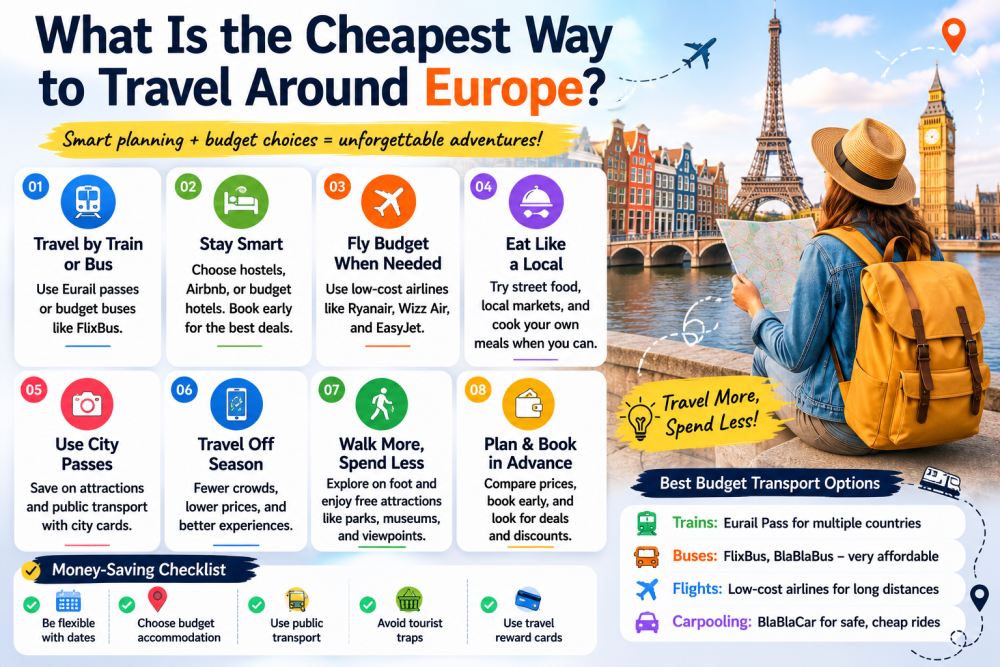
The bus. There's the answer, unglamorous and undefeated: for pure cost per kilometer, Europe's intercity bus network, FlixBus and its regional cousins, beats everything else on the continent, with advance fares between major cities routinely in the single and low double digits. If the question was only ever about the cheapest single mode, you're done, that's it, green buses, book early, bring snacks.
But nobody travels Europe on one mode, and the actually-cheap trip is a mix: buses for the short and medium hops, budget flights for the long jumps where a bus becomes a punishment, trains exactly where trains are cheap (which is a specific and learnable map, not everywhere), rideshares filling the gaps, and night routes doing the beautiful double duty of transport plus bed. This article is that mix, mode by mode, with the honest math on the famous rail pass, the timing rules per mode, and the routing strategy that ties it together, the deep destination detail living in our budget Europe guide.
Buses: The Undefeated Baseline
FlixBus turned European bus travel into a single bookable network, and the value is genuinely absurd when booked ahead: cross-border hops for what a city taxi costs, comfortable enough coaches, wifi of fluctuating honesty, and coverage that reaches places the rails forgot. The regional players matter too, national carriers, and in the Balkans, the gloriously informal minibus culture our budget Europe guide relies on, which goes everywhere, cheaply, on schedules best described as folklore.
The bus rules: book days to weeks ahead for the headline fares, walk-up prices are merely fine rather than magical. Respect the distance ceiling, up to about six hours a bus is smart money, beyond eight it's a test of character, and that's exactly where the calculus flips to flights or night routes. And mind the station locations, usually central, occasionally a mystery industrial estate, check before booking the 6am departure.
Budget Flights: For the Long Jumps Only
Everything in our cheap flights guide applies at full strength inside Europe, compressed here to the continental version: the low-cost carriers sell genuine bargains on the long jumps, Lisbon to Warsaw, London to Athens, the routes where ground transport costs a day of your life, with the whole true-cost quiz attached, the bag fees, the out-of-town airports whose transfer buses quietly eat the savings, the hand-luggage game you either play properly or pay for.
The strategic rule that makes flights and buses teammates rather than rivals: fly the jumps, ride the regions. A trip shaped as one or two cheap flights between regions, with buses and trains doing all the movement within them, beats both the all-flights itinerary (airport days everywhere, luggage fees compounding) and the all-ground purist route (three days of your holiday spent watching motorways). Let the fare map pick which regions, per the flights guide, then go overland inside them.
Trains: Cheap Exactly Where They're Cheap
The train question confuses people because both reputations are true. Western Europe's walk-up fares are genuinely expensive, and the same corridors sell advance fares, booked weeks ahead on the national operators' sites, that compete with buses while being twice as pleasant. Meanwhile Eastern and much of Central Europe never got the memo that trains should cost money: regional fares across Poland, Czechia, Hungary, Romania, the Balkans run to pocket change, no advance booking needed, and some of those windows, the Carpathian lines, the coastal runs, are the trip.
So the train rule has two halves: west of roughly Germany, trains are an advance-booking game you play early or skip; east of it, trains are the default you can decide on the platform. And everywhere, the regional and slow services undercut the express ones by margins that reward the unhurried, which budget travelers, by definition, are.
Now the famous pass. The Interrail/Eurail honest math: for most budget itineraries, the pass is not the cheapest option, point-to-point advance fares and buses beat it on pure cost, and the high-speed trains it theoretically covers charge seat reservation fees on top that surprise every first-time holder. Where the pass genuinely earns its price: trips built on spontaneity, deciding tonight where tomorrow goes, heavy train-day itineraries in the expensive west, and the under-27 youth pricing, which shifts the math meaningfully. Buy it for flexibility, knowingly, or skip it for arithmetic, also knowingly. Just don't buy it assuming pass equals cheapest, that's the single most common European transport mistake.
The Gap Fillers: Rideshare and the Night Double
BlaBlaCar, the long-distance rideshare, is the mode nobody's guidebook mentions and half of Europe's young travelers quietly use: intercity seats in locals' cars at prices between bus and train, on routes and times the timetables ignore, with the bonus of an hour's conversation with an actual resident. Standard sensible-stranger rules apply, profiles, ratings, the solo travel guide's instincts, and it particularly shines where France and Spain's buses thin out.
And the night routes, the budget traveler's compound interest: a night bus or sleeper train converts a travel day into a travel sleep, saving a night's accommodation while the kilometers happen, effectively making the ticket half price against the hostel bed it replaced. The honest fine print: night buses are a skill acquired through suffering (neck pillow, aisle seat strategy, low expectations), sleeper trains are the civilized version worth their modest premium, and either way, arrive-at-dawn plans should respect our solo guide's arrival protocol, groggy is the state pickpockets order in advance.
The Routing Strategy and the Sample Math
Pulling it together, the shape of cheap European movement: pick two or three regions rather than a continental sampler, per the budget Europe guide, the Schengen clock in our visa guide permitting, fly the one or two long jumps between them on fares booked when the alerts fire, then move inside each region by bus-first defaults, trains where you're east or booked early, BlaBlaCar for the awkward gaps, and a night route wherever a six-plus-hour leg lines up with a hostel bill you'd rather not pay.
The sample math, painted in honest ranges: a three-week, two-region trip might carry one budget flight in the tens of euros booked ahead, a dozen bus and regional train hops at single-to-low-double-digit fares each, and one or two night legs saving their own fare in beds, landing total transport somewhere around the cost of three or four nights' accommodation. Compare that with the all-flights version or the unexamined rail pass and the mixed strategy wins by enough to fund a week's food. Movement, done right, is the cheapest major line in a European budget, which surprises everyone whose reference point was a single walk-up train fare in the expensive west.
The Bottom Line
The cheapest way around Europe is a stack, not a mode: buses as the default, booked ahead, under the six-hour ceiling, budget flights reserved for the long jumps and played by the true-cost rules, trains ridden freely in the cheap east and booked early or skipped in the pricey west, the rail pass bought for flexibility or not at all, BlaBlaCar in the gaps, and night routes collecting the transport-plus-bed double whenever the map allows.
Master the stack and getting around becomes the budget line you stop worrying about, which is the real prize: the money stays for the places, per the destinations guide, and the moving between them fades into cheap, scenic background. Green buses and window seats. Europe's been affordable all along, it just doesn't advertise the good routes.
FAQs: Cheap Travel Around Europe
What is the single cheapest transport in Europe?
Intercity buses, FlixBus and the regional networks, win on pure cost per kilometer, with advance fares between major cities routinely in single and low double digits. The realistic cheapest trip mixes modes, buses as default, budget flights for long jumps, cheap eastern trains, night routes, but if forced to one answer: the bus, booked early.
Is a Eurail or Interrail pass worth it?
Usually not on pure cost, point-to-point advance fares and buses beat it for most budget itineraries, and high-speed trains add seat reservation fees on top of the pass that surprise first-timers. It earns its price for spontaneous trips where flexibility is the product, train-heavy routes in expensive Western Europe, and under-27 youth pricing. Buy it for freedom, not for savings.
Are trains or buses cheaper in Europe?
It depends where you're standing: buses win almost everywhere on walk-up price, Western European trains compete only via advance fares booked weeks ahead, and Eastern and Central European regional trains are so cheap the question dissolves, decide on the platform. The working rule: buses by default, trains freely in the east, trains in the west only with early booking.
How do night buses and trains save money?
They merge a travel day with a night's accommodation: the kilometers happen while you sleep, and the hostel bed you didn't book effectively refunds half the ticket. Sleeper trains are the comfortable version worth their small premium; night buses are the hardcore-budget version and an acquired skill. Both reward arriving-at-dawn plans made with a clear head the night before.
Is BlaBlaCar safe and worth using?
It's mainstream across much of Europe, particularly France and Spain, with prices between bus and train and coverage on routes timetables miss. The platform's profiles and ratings do the vetting work; apply the same judgment you'd use with any stranger arrangement, share plans per the solo-travel playbook, and it's both a bargain and frequently the most interesting hour of the day.
How much should I budget for transport traveling Europe for a month?
With the mixed strategy, buses booked ahead, one or two budget flights for long jumps, cheap eastern trains, a night route or two, transport for a two-or-three-region month commonly lands around the price of a handful of accommodation nights, a modest slice of the total budget. The figure balloons only under the classic mistakes: all-flights itineraries with bags, walk-up western train fares, and passes bought on assumption rather than arithmetic.