Mathematically? Highest interest rate first, every time, no debate. Psychologically? Whichever method you'll still be following in month eight. And the smartest way to pay off debt is where those two answers overlap, which is different for different people, and pretending otherwise is why so much debt advice fails the humans it's aimed at.
So this article does the whole job: the ground you prepare before aggressive payoff makes sense, the two famous methods compared without tribal loyalty, the consolidation tools that genuinely help and the products wearing their costume, and the traps, some of them respectable-looking, that keep people stuck for years. Debt is heavy enough without bad directions.
The plain-voice disclaimer, because money articles owe you one: general information, not personal advice, rules and products differ across the US, UK, Canada, and the Gulf, and if your situation involves collections, legal threats, or genuine hardship, a nonprofit credit counselor or licensed advisor in your country beats any article, this one included. That's not a formality. For some readers it's the actual smartest move on this page.
Before the Payoff: Stop the Bleeding
Aggressive debt payoff on an unstable base collapses, so three pieces of ground-laying come first, and they take a week, not a season.
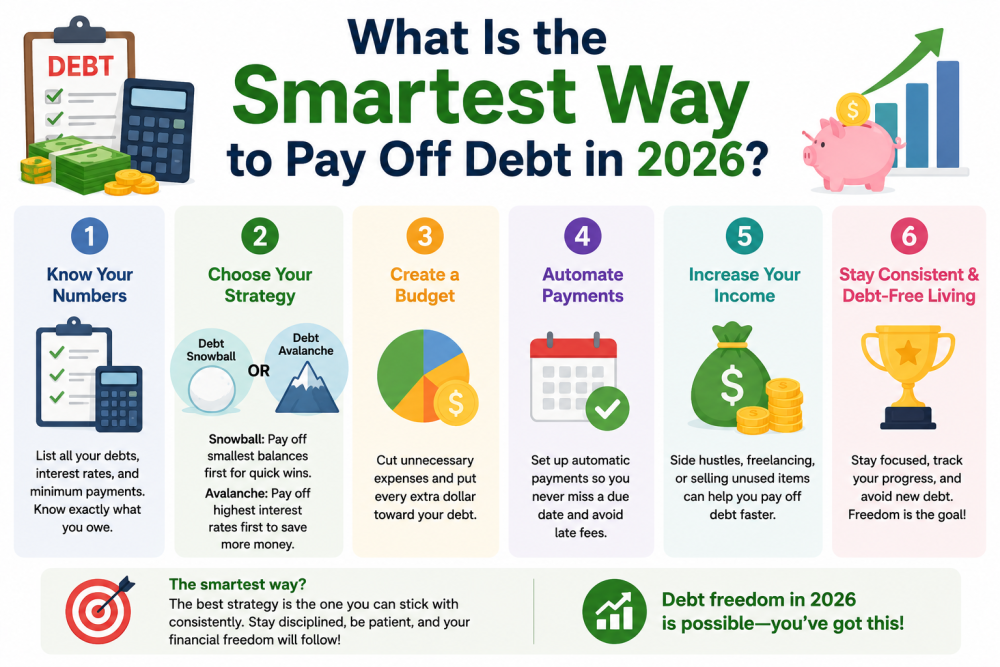
Know the full picture. One list, every debt: balance, interest rate, minimum payment. Most people have never made this list and are carrying a fog instead of a number, and the fog is heavier. The list hurts for about ten minutes and then, almost universally, feels better than the not-knowing did.
Cover every minimum, always. Minimum payments are the floor that keeps penalties, rate hikes, and credit damage from making everything worse. The payoff strategies below are about where extra money goes, on top of minimums, never instead of them.
And build a small buffer first, a few hundred, maybe a month's essentials, before going scorched-earth on the debt. Counterintuitive, aiming money at savings while carrying expensive debt, but here's the mechanism: without a buffer, the first car repair goes straight back on the card, and the cycle you're fighting refinances itself. The mini-fund isn't a detour from payoff. It's the thing that makes payoff stick. Our guide to saving on a low income covers building it fast.
The Two Methods, Compared Like an Adult
Avalanche: extra money attacks the highest-interest debt first while everything else gets minimums, then the next-highest, and so on. This is the mathematically correct answer, full stop, it minimizes total interest paid and finishes fastest on paper. When the gap between your worst rate and your best is large, a 25 percent card versus a 7 percent loan, avalanche's advantage is real money, sometimes thousands.
Snowball: extra money attacks the smallest balance first, regardless of rate, killing whole debts quickly and rolling each freed payment into the next target. Mathematically inferior, sometimes barely, sometimes meaningfully. Behaviorally, it's a weapon: cleared debts are victories you can feel, the shrinking count builds momentum, and the research on debt payoff keeps finding the unglamorous truth that people who feel progress keep going, and people who keep going beat people with better spreadsheets who quit.
The adult resolution: if your rates are clustered close together, the methods barely differ, pick snowball and enjoy the wins. If one debt's rate towers over the rest, that debt is a fire and avalanche is the hose, feelings can have the second-highest one. And the hybrid most real people land on: kill one or two tiny balances first for the momentum, then avalanche the rest. Nobody's spreadsheet is offended by that, and it works.
Either way, automate the attack. The extra payment leaves on payday, by standing order, before the month can vote on it. Willpower is for choosing the plan, not for executing it 36 times.
Consolidation: The Tools and the Costumes
Consolidation means swapping expensive debt for cheaper debt, and done right it's a genuine accelerator. Done wrong it's a costume change.
The real tools. Balance-transfer cards with zero-percent introductory windows can freeze interest on card debt for a year or more, which turns every payment into pure principal, powerful, with three honest catches: a transfer fee up front, a rate that snaps back hard when the window closes, and the requirement, this is the whole game, that you don't run new spending up on the old, now-empty cards. A consolidation loan does a similar swap at a fixed rate with a fixed end date, and the discipline it enforces, one payment, a real finish line, suits many people better. In both cases the test is arithmetic: total cost after fees, lower than the current path, or it isn't consolidation, it's shuffling.
The costumes. Debt settlement companies advertising to "slash your debt" typically tell you to stop paying creditors while they negotiate, torching your credit and charging heavy fees for outcomes you can often pursue free. Payday loans and their app-shaped descendants are the opposite of a payoff strategy at triple-digit effective rates. And stretching short-term debt across the longest possible term just to shrink the monthly payment can double what you repay, a lower payment is not the same as less debt, read the total.
Two moves people skip because they sound too simple: call your card company and ask for a lower rate, long-standing customers succeed at this more often than anyone expects, and if things are genuinely tight, ask about hardship programs before missing payments, not after. Creditors negotiate more readily with people who call early. And nonprofit credit counseling agencies, in most of our readers' countries, will review your situation free and can set up structured repayment plans with reduced rates, they are the legitimate version of everything the settlement ads pretend to be.
Keeping It Dead: The Part Nobody Writes About
Paying off debt twice is a common story, and the sequel is always worse, so the endgame matters. As balances die, redirect the freed payments, first to finishing the emergency fund properly, three to six months of essentials, because that fund is the structural answer to the question "how do I never do this again." Then the same automated payment that killed the debt becomes the one that builds savings and, eventually, investments, the order-of-operations we laid out in our beginners' investing guide, high-interest debt first, always, which you'll notice you've already obeyed.
And watch the refill valves: the paid-off card with a suddenly clean limit, the BNPL buttons that reinstall the exact sprawl you just escaped, the lifestyle creep that arrives the month the payments stop. Keeping one card for credit health and closing or freezing the rest is a personal call with real trade-offs, but the principle underneath isn't: the habits that cleared the debt are the same ones that keep it cleared, and they're cheaper to maintain than to rebuild.
The Bottom Line
The smartest way to pay off debt in 2026: list everything, cover minimums, build the small buffer that breaks the borrowing cycle, then aim every spare unit of money at the debt using avalanche if one rate towers over the rest, snowball if you need the wins to keep going, or the kill-two-small-then-avalanche hybrid that most people actually sustain. Consolidate only when the total math says so, call your creditors before trouble instead of after, use nonprofit counseling instead of settlement ads, and when the last balance dies, redirect the payment into the fund that makes this a story you tell once.
The math method saves the most interest. The method you'll actually finish saves the most life. Choose accordingly, automate ruthlessly, and let month eight take care of itself.
FAQs: Paying Off Debt
Should I use the avalanche or snowball method?
Avalanche (highest rate first) is mathematically best and matters most when one debt's rate towers over the others. Snowball (smallest balance first) sacrifices some math for momentum, and momentum is what keeps real people going for years. If your rates are clustered, the difference is small, pick the one you'll sustain, or kill two small debts first and avalanche the rest.
Should I save money or pay off debt first?
A small emergency buffer comes first, a few hundred to one month of essentials, because without it, the first surprise expense goes straight back on the card and restarts the cycle. After that, high-interest debt beats almost any saving or investing, paying off a 20-plus percent card is a guaranteed return nothing legitimate matches. Full emergency fund and investing come after the expensive debt dies.
Is debt consolidation a good idea in 2026?
When the arithmetic works, yes: a zero-percent balance transfer or a fixed-rate consolidation loan that lowers your total cost after fees genuinely accelerates payoff. It fails when it's used to lower monthly payments by stretching the term, or when the emptied cards get refilled. Run the total-cost math, and treat debt settlement companies as a separate, worse category, nonprofit credit counseling does their legitimate job free or cheap.
Can I negotiate my debt or interest rate myself?
More often than people believe. A call to your card company asking for a rate reduction succeeds regularly for customers in decent standing, and creditors offer hardship programs to people who call before missing payments. For heavier situations, nonprofit credit counseling agencies negotiate structured plans with reduced rates on your behalf, legitimately and usually free to start.
How fast should I try to pay off my debt?
As fast as your real budget allows after minimums and the small buffer, with one caution: plans that require a joyless, unlivable budget tend to collapse around month three and take morale with them. A slightly slower plan with a small built-in allowance for being human finishes more often than a maximal one that doesn't, and finishing is the entire point.
What debts should I pay off first in 2026?
By rate, worst first: payday-style loans and anything with triple-digit effective rates are emergencies, then credit cards and BNPL balances, then personal loans, with low-rate long-term debt like reasonable mortgages last, those generally coexist with normal saving and investing. Within that order, the avalanche-versus-snowball choice is about you, not the debts.