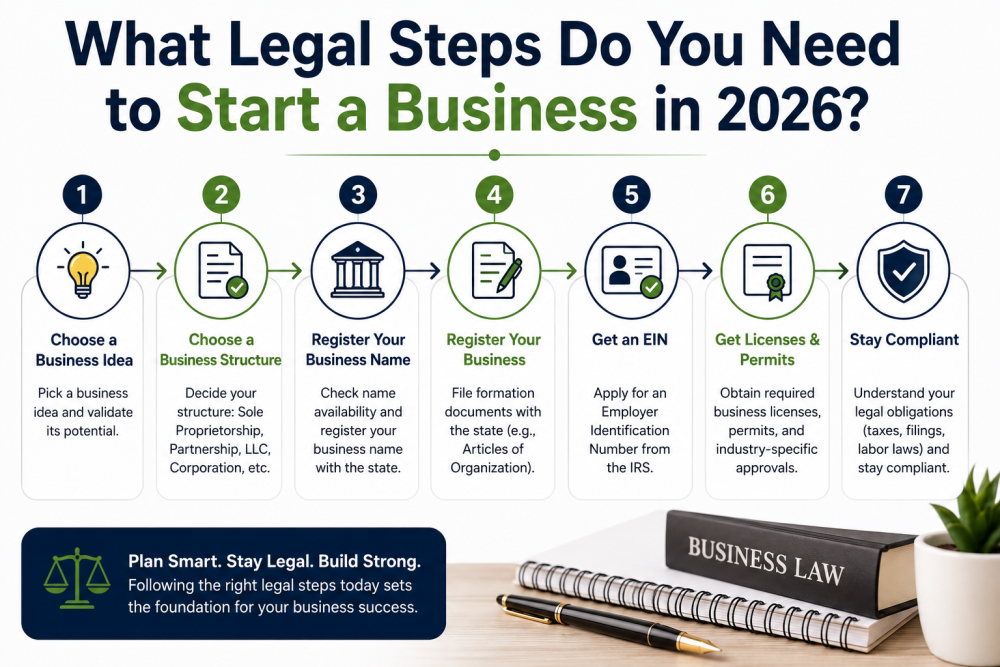
The legal side of starting a business generates two opposite mistakes, and both are expensive. Mistake one: doing nothing, trading for a year with no registration, no insurance, no separation between your money and the business's, and discovering the gaps the day something goes wrong. Mistake two: doing everything, spending months and serious money on structures, trademarks, and lawyer-drafted everything before a single customer exists, which is procrastination wearing a suit.
The cure for both is the same: sequence. Legal steps aren't a pile, they're a timeline, some belong before your first sale, some belong at real revenue, some belong the day you hire, and knowing which is which saves both the fines and the wasted fees. That timeline is this article.
Two ground rules before it starts, both load-bearing. First, the disclaimer that actually matters here: this is general information, not legal advice, and the specifics, forms, thresholds, names of structures, differ substantially between the US, UK, Canada, the Gulf, and between states, provinces, and emirates within them, so treat this as the map of what to check, and your government's official business portal plus, at the right moments, a local professional as the territory. Second, the good news the fear-sellers skip: in most of our readers' countries, starting simply is genuinely simple, an afternoon on official websites, modest fees, and the heavy machinery deferred until the business earns it.
Stage One: Before the First Sale
Four items belong before money changes hands, and only four.
Pick the simplest legal shape that fits. Every country offers a spectrum from "just you, trading" (sole trader, sole proprietorship, and their local cousins) to separate legal entities (the LLC, the limited company, the local equivalent). The honest starter guidance: the simple end is faster, cheaper, and fine for most low-risk service businesses at the start, while the separate-entity end buys liability protection, if the business is sued or owes money, your personal assets have a wall, at the cost of more admin and fees. The riskier the activity and the bigger the contracts, the earlier the entity makes sense; plenty of freelancers run simple for years, plenty of trades and product businesses incorporate on day one for the liability wall alone. This is also the decision where a one-off session with a local accountant pays for itself, structure choice has tax consequences that differ by country, and reversing it later is annoying.
Register where your jurisdiction requires it. Here's where "it depends" earns its keep: some places let sole traders simply start and register with the tax authority by a deadline; others require registration or licensing before trading, and specific industries, food, health, finance, childcare, transport, carry their own licenses everywhere. The reliable method: your government's official business portal (every country our readers live in has one), search your business type, and make the checklist from the source rather than from forums. One afternoon, and you know exactly what your situation requires instead of what someone else's did.
Open a separate bank account. Not glamorous, absurdly important: mixing business and personal money makes your bookkeeping fiction, your taxes painful, and, if you formed an entity for liability protection, can actually undermine that protection. Separate account, all business in and out through it, from the first sale.
And insurance, before the first job anywhere your work touches other people's property, bodies, or premises. Public liability and its relatives cost little, and our low-cost business guide's line remains true: it's cheaper than one incident by orders of magnitude. Professional advice businesses add indemnity cover; anyone with premises or equipment insures those. Ten minutes with a comparison site or broker.
Stage Two: At Real Revenue
Once money flows regularly, the second wave.
Tax registration and the self-employment reality. Wherever you are, income needs reporting, and the working rule from our side hustle coverage applies: roughly a quarter to a third of self-employed income isn't yours, park it as it arrives. Two thresholds to put on your radar early because they arrive with growth: the consumption-tax registration point, VAT, GST, sales tax nexus, every system has one, crossing it unregistered is a classic expensive surprise, and estimated or advance tax payments, which several countries require once income is real. This stage is exactly when a local accountant converts from luxury to bargain, one annual engagement typically saves more than it costs and removes the fear layer entirely.
Contracts in writing, always. Nothing fancy required at first, a plain agreement covering what's being delivered, by when, for how much, paid how and when, and what happens on cancellation, prevents the majority of business disputes before they exist. Reputable template sources cover the standard cases; the moment for a lawyer's hour is any deal big enough to hurt, any contract someone else drafted and pushed at you, and anything with equity, exclusivity, or long commitments in it. Reading before signing is a legal step, technically, and the most skipped one in commerce.
Basic record keeping, because every tax authority on earth agrees on one thing: keep the records. Invoices out, receipts in, bank statements, from day one, in software or a disciplined folder, retention periods vary by country and are always years, not months. Future you, mid-audit or mid-loan-application, sends thanks.
And customer data duties, if you hold any: names, emails, payment details put you inside privacy rules, GDPR and its international cousins, and the small-business version of compliance is mostly hygiene, collect only what you need, store it in reputable tools, never paste it into consumer-grade AI (our AI data safety guide covers that whole territory), and know how you'd delete someone's data if asked.
Stage Three: The Step-Changes
Certain events change your legal weight class overnight, and knowing them in advance beats meeting them by surprise.
Hiring the first person is the big one, everywhere: employment law arrives as a package, contracts, payroll and withholding, workplace insurance, statutory rights, and this is a genuine "get proper local guidance" moment rather than a template moment, employee misclassification (calling employees contractors) being the classic and heavily penalized shortcut. Taking investment or a partner: paper it properly, ownership percentages, decision rights, exit terms, because the partnerships that end in court are almost always the ones that started on a handshake between friends. Trademark, per our zero-budget brand guide, graduates from skip-list to sensible once there's a name genuinely worth defending and revenue behind it, country processes vary, and it's a when-not-if for anything that's working. And crossing borders, selling into new countries, brings the tax-and-rules question fresh for each one; the day that's real is another professional-hour day.
The Bottom Line
The legal path to starting a business in 2026, staged honestly: before the first sale, pick the simplest fitting structure, register what your official portal says your situation requires, open the separate account, and insure anything that touches people or property. At real revenue, register for the taxes that now apply, put every agreement in writing, keep records like the audit is scheduled, and mind any customer data you hold. And treat hiring, partners, investment, and borders as the step-changes they are, each worth a professional's hour before, not after.
None of it, done in order, is expensive or slow, and all of it beats both failure modes: the unregistered year that ends in penalties, and the perfectly incorporated business that never got its first customer. Do stage one this week. Then go sell something, that part's still the actual business.
FAQs: Legal Steps for New Businesses
Do I need to register my business before making any money?
It genuinely depends on where you are: some jurisdictions let sole traders begin and register with tax authorities by a set deadline, others require registration or licenses before trading, and regulated industries need licenses everywhere. The reliable answer comes from your government's official business portal for your specific type and location, an afternoon's reading, straight from the source.
Should I start as a sole trader or form a company (LLC)?
The simple structure is faster, cheaper, and adequate for most low-risk service businesses at the start; the separate entity buys a liability wall between business troubles and personal assets, at the price of more admin, and earns its keep earlier for risky activities, physical work, products, big contracts. Structure has tax consequences that differ by country, so a one-off session with a local accountant before choosing is money well spent.
What insurance do I legally need for a small business?
Requirements vary by country and industry, but the practical floor is public liability cover before the first job anywhere your work touches people, property, or premises, with professional indemnity added for advice-based work and employer's coverage becoming mandatory in most places the day you hire. It's among the cheapest protections in business, and operating bare is the false economy that defines cautionary tales.
When do I need to worry about VAT, GST, or sales tax?
When revenue approaches your jurisdiction's registration threshold, every consumption-tax system has one, and crossing it unregistered is the classic expensive surprise. Find your threshold on the official tax site the week your revenue becomes regular, track toward it, and register on time; some businesses even register early voluntarily where reclaiming tax on purchases makes it worthwhile, which is an accountant question.
Do I need a lawyer to start a business?
For most simple starts, no, official portals and reputable templates cover stage one. The moments that genuinely earn a professional's hour: choosing a structure where tax consequences are unclear, any contract large enough to hurt or drafted by the other side, hiring your first employee, taking partners or investment, and anything involving equity or exclusivity. Buy expertise at the decision points, not by the month.
What legal mistakes do new businesses make most?
The classics, in rough order of damage: mixing personal and business money in one account, trading uninsured in physical or advice work, handshake deals with partners and big clients, missing the consumption-tax threshold, misclassifying employees as contractors after hiring, and the quiet one, keeping no records until the tax deadline forces archaeology. Every one is cheap to prevent and expensive to repair, which is the entire argument for the staged checklist.