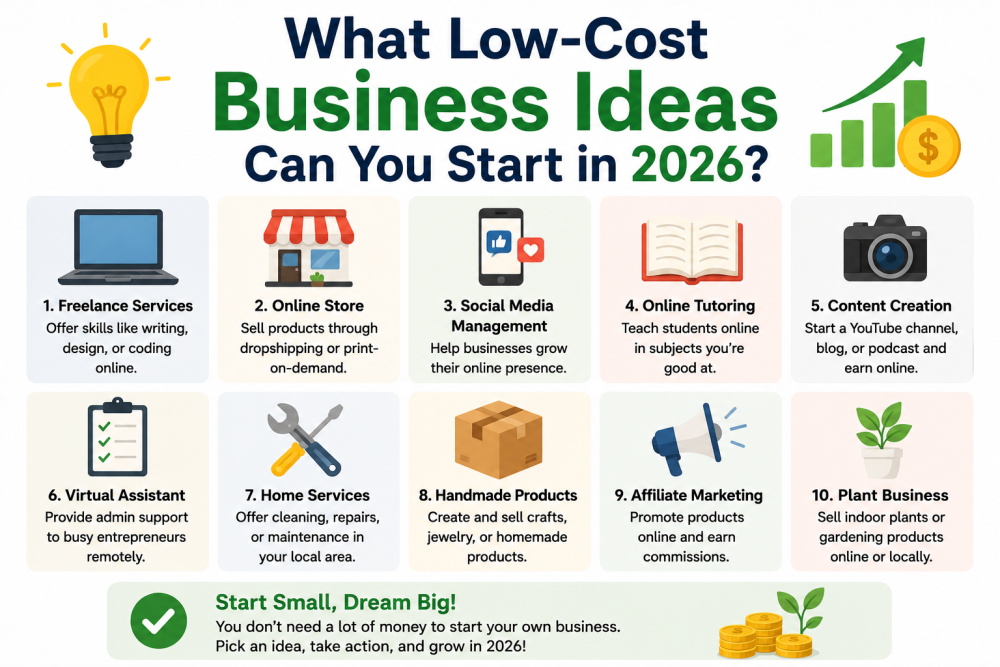
Under a thousand dollars. That's the ceiling for everything in this article, most of it starts under five hundred, some under a hundred, and every idea here is a real business, meaning something with customers, repeat revenue, and a price you set, not a gig where an app sets it for you.
That distinction matters more than any idea on the list. A gig pays you for hours. A business builds something that can grow past your hours: a customer list, a reputation, a booked-out calendar you can raise prices on. Plenty of the ideas below start looking like gigs and become businesses the moment you get systematic about them, and the ones that make owners real money in 2026 share three boring traits: low startup cost, repeat customers baked in, and a service people already pay for, no market education required. Right, the list, sorted by what you're working with.
If You've Got Hands and a Vehicle: Local Services
The unfashionable goldmine. Local service businesses are the highest-probability path from a few hundred dollars to a real income that exists, because demand is permanent, competition is often lazy, and customers rebook forever.
Cleaning leads the category, homes, offices, move-out deep cleans, with startup costs around $100 to $300 for supplies and the first insurance payment, and rates that climb steeply once reviews stack. The businesses that win here don't clean better, they show up reliably and communicate like professionals, which tells you everything about the competition.
Pressure washing and exterior work: a capable machine runs $300 to $600, driveways and siding are satisfying before-and-after content that markets itself, and a weekend operator clearing several hundred per day is normal in season. Mobile car detailing sits in the same family, $200 to $500 of supplies, customers who rebook monthly, and offices and driveways as your venue.
Then the time-givers: laundry pickup and delivery, errand and senior-assistance services, home organizing. Startup costs are nearly nothing, a phone, insurance, bags or bins, and the customer isn't buying the task, they're buying hours of their life back, which is the single easiest thing to sell to busy households in 2026. Senior services deserve a special flag: demographics guarantee the demand curve for decades, and trust plus punctuality beats any marketing budget in that market.
Pet businesses round it out, walking, sitting, mobile grooming at the pricier end, because pet spending has proven immune to every economic mood, and a dozen recurring walk clients is a quietly excellent base income.
If You've Got a Laptop and a Skill: Digital Services
We've covered freelancing-from-zero in depth elsewhere on the site, so here's the business-shaped version in brief: the move in 2026 is the productized service, one specific outcome, one fixed price, sold repeatedly. Not "I do marketing," but "I'll set up and manage your Google Business Profile, monthly fee." Not "designer," but "podcast cover and episode graphics package, flat rate." Bookkeeping-as-subscription for five small businesses. Website tune-ups for one industry you know.
Startup cost is software subscriptions, under $100 to begin, and the leverage is that a productized offer gets easier and faster every time you deliver it, while custom work starts from zero each round. Add the AI toolkit every solo operator now runs and one person delivers what a small team did a few years ago. Pick a niche where you already speak the language, that's the whole secret, and the first three clients usually hide in your existing contacts.
If You Can Cook: The Cottage Food Route
Home food businesses got genuinely viable as cottage food laws spread across US states and equivalents settled elsewhere, letting you sell certain homemade foods, baked goods leading, legally from a home kitchen with registration rather than a commercial lease. Startup: roughly $100 to $500 across registration, packaging, and ingredients, plus an honest afternoon reading your local rules, which vary a lot and matter.
The models that work: a signature item sold through weekend markets and pre-orders, celebration cakes and custom bakes, meal-prep for a specific diet niche sold by weekly subscription, that last one being the sleeper, because subscription revenue turns cooking into a business with a predictable Monday. Margins on baked goods run strong, and the marketing is Instagram plus the market stall plus word of mouth doing what it's done for food since forever.
If You've Got an Eye: Resale as a Business
Flipping graduates from side hustle to business the moment you specialize. The generalist sells their garage; the business owner picks a lane, vintage clothing, mid-century small furniture, specific electronics, gym equipment, refurbished appliances at the ambitious end, learns its prices cold, and sources on a schedule: thrift runs, estate sales, marketplace alerts, auction lots.
A few hundred dollars of starting inventory is plenty, the skill compounds monthly, and the lane knowledge is the moat, the vintage dealer spots the $200 jacket at the $8 rail in seconds, and that eye took a hundred hours to build, which is precisely why competitors can't shortcut it. Storage is the constraint to respect early; profitable flippers with unlivable apartments are a genre.
The Ideas I'd Skip, Briefly
Equal time for the money-savers. Vending machines and claw machines, the passive-income video staple, real machines in good locations cost far more than the thumbnails admit, and good locations are the entire business. Dropshipping as a first business, it's an ad-buying business wearing a store costume, we've made this case elsewhere. Anything requiring a franchise fee, inventory package, or "starter kit" at this budget level, that's someone else's business idea being sold to you, at margins that explain the selling. And courses about starting businesses, the eternal exception being that the people selling them did, technically, start a business.
Whichever You Pick: The First Five Customers
Every idea above shares one launch sequence, so here it is once. Set up the minimum professional shell: a Google Business Profile for anything local, since it's free and it is your website for year one, a payment method, and insurance where the work touches homes, vehicles, or food, non-negotiable, and cheaper than one incident. Price against the local market, not your self-doubt, low-but-not-lowest wins early reviews without setting a trap you can't escape.
Then get the first five customers from warm ground: your contacts, neighborhood groups, one clear offer stated plainly. Over-deliver stupidly on those five, ask each for a review and a referral at the happy moment, and let the flywheel we've written about elsewhere, reviews feeding search, service feeding referrals, do what it does. Every boring successful local business you know started exactly this unglamorous way. That's not discouraging. That's the good news, the path has no secret sections.
The Bottom Line
The best low-cost businesses of 2026 cluster where they've always clustered, with better tools: local services with repeat demand, cleaning, exterior work, pet care, time-giving errands, productized digital skills sold at flat rates, home food under cottage rules, and specialized resale. All launch under $1,000, most under $500, and all share the traits that matter, existing demand, rebooking customers, prices you control.
Pick the one that matches what you've already got, hands, laptop, kitchen, or eye, run the five-customer launch sequence, and treat month one's clumsiness as tuition, everyone pays it. A year of systematic boring later, you own something that grows past your hours, which was the entire point of choosing a business over a gig.
FAQs: Low-Cost Business Ideas
What's the cheapest business to start in 2026?
Digital services and time-giving local services, errands, organizing, pet walking, launch for under $100, essentially a phone, basic insurance where relevant, and a Google Business Profile. Cleaning starts around $100 to $300 with supplies. The cheapest viable business is generally the one using tools and skills you already own.
Which low-cost business is most profitable?
Per hour once established, productized digital services and specialized resale lead, expertise pricing with minimal costs. For dependable build-up, local services win: cleaning, detailing, and pressure washing reach strong day rates with rebooking customers, and their profitability comes from reliability commanding premium prices in markets where showing up on time is rare.
Can I start a business while working full-time?
Most of this list is designed for exactly that: weekend pressure washing and detailing, evening and weekend cleaning slots, resale sourced on Saturdays and listed at night, digital services delivered around a job, market-day baking. The standard path is nights-and-weekends until the business income makes the decision for you, not a leap of faith on day one.
Do I need to register a business and get insurance first?
Insurance, yes, before the first paying job anywhere your work touches homes, vehicles, or food, it costs little and one incident without it costs everything. Formal registration rules vary by country and state; many places allow starting as a sole trader with registration once income is real, while food businesses need their local cottage-food registration upfront. An afternoon on your local government's site settles both.
What business ideas should I avoid on a small budget?
Anything where your startup money buys someone else's product rather than your capability: franchise-style fees, inventory packages, vending machines at too-good prices, dropshipping "systems," and courses promising the secret. The pattern is identical, the seller's business is selling starts. Real low-cost businesses spend the first money on tools, insurance, and supplies, things that do work, not things that promise it.
How long until a low-cost business replaces a job income?
With consistent part-time effort, the typical arc is: first customers in weeks, meaningful side income at three to six months, and a genuine full-time-income decision somewhere in year one or two, faster for local services in underserved areas, slower where you're building specialized reputation. The compounding is real but back-loaded, reviews, rebooking, and referrals all accelerate with time served.