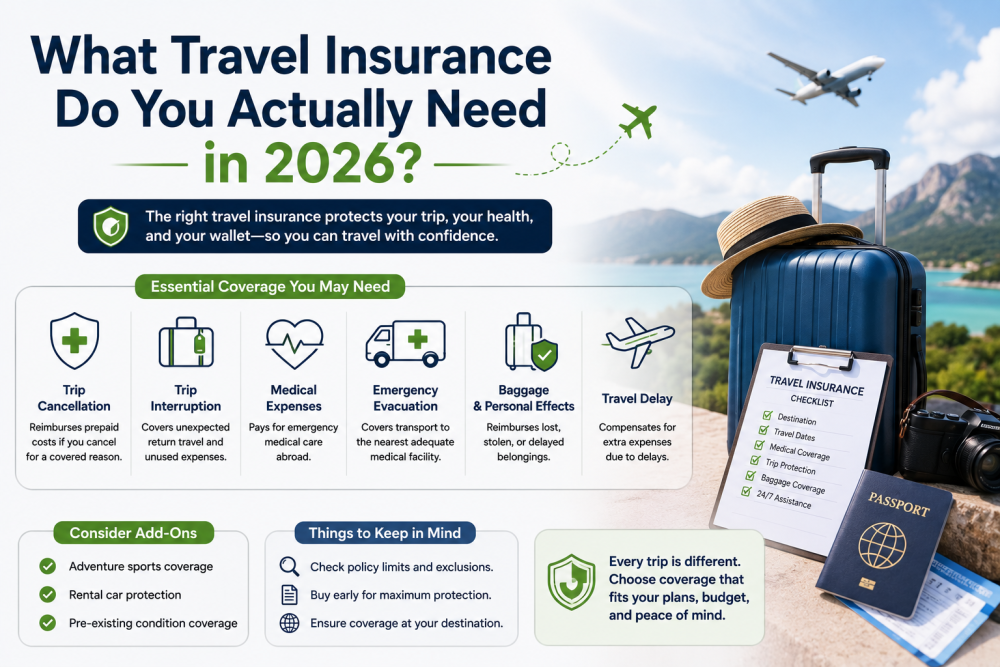
Travel insurance is one product wearing five costumes, and the entire skill of buying it is knowing which costume is the actual product. Here's the answer up front: emergency medical cover, plus medical evacuation, is the whole point, the only part protecting you from genuinely ruinous numbers, and everything else on the policy, the cancellation cover, the baggage payout, the delay compensation, is garnish, nice, small, and never worth choosing a policy over.
That single reframe fixes most travel insurance mistakes, because people shop the garnish, comparing cancellation limits and baggage payouts, and skim the medical section where the real stakes live. So this article does it in the right order: the medical core and what limits actually make sense, the fine print that quietly voids claims (this section will save someone reading it a five-figure sum, it does every time), the truth about the insurance your credit card claims to include, and the honest math on annual policies, cancellation cover, and everything skippable.
The usual line, sincerely: general information, not financial or insurance advice, products and rules vary by country of residence, and your policy's actual wording beats anything any article says, including this one.
The Core: Medical and Evacuation, the Only Ruinous Risks
Rank travel disasters by financial damage and the list has a cliff in it. Lost bag: hundreds. Cancelled trip: the trip's cost, painful, survivable. Serious illness or accident abroad: potentially tens or hundreds of thousands, hospital care in expensive destinations, the USA being the world's most brutal example, runs to numbers that end financial lives, and a medical evacuation, the air-ambulance flight home or to adequate care, can alone cost more than a car. Those two items are why travel insurance exists. Everything else is packaging.
So the buying checklist starts and nearly ends here: emergency medical cover with a limit that matches your destination's healthcare costs, generous for the US, Canada, and Japan tier, still meaningful everywhere, and medical evacuation and repatriation explicitly included, not assumed. Our solo travel guide calls insurance the one non-negotiable spend in the entire budget, and this is the section of the policy that sentence was about. A policy costs a few percent of the trip. The risk it covers is the only one that doesn't cap at the trip's value.
Two honest notes for specific readers. Travelers with pre-existing conditions: declare them, always, the premium bump is real and the alternative, a claim denied for non-disclosure while hospitalized abroad, is the worst outcome in this entire topic. And travelers from countries with reciprocal healthcare schemes, the UK's GHIC in the EU being the famous example: those arrangements are genuinely useful and genuinely partial, they don't cover evacuation, repatriation, or the private care you may end up in, so they complement insurance rather than replace it.
The Fine Print That Eats Claims
Insurers pay most legitimate claims, and the ones they refuse cluster around the same clauses every year, so, the field guide, learned cheaply here rather than expensively there.
The activities list is the big one. Standard policies cover standard tourism, and the things budget travelers actually do, scuba diving, skiing, trekking above certain altitudes, and the giant one for anyone using our Southeast Asia guides, riding motorbikes and scooters, frequently need an add-on or sit excluded entirely. The motorbike clause deserves its own sentence: many policies only cover riding if you hold a valid motorcycle license from home and wear a helmet, which quietly excludes a huge share of the tourists renting scooters across Asia, and scooter accidents are precisely the claim they'll be trying to make. Read the clause before renting, not after.
Alcohol clauses: injuries sustained while intoxicated are excludable on most policies, and insurers do invoke it. The unattended-belongings clause: theft of bags left unattended, or valuables not on your person or in a safe, is routinely refused, which is really a restatement of our solo guide's habits with a financial penalty attached. And the documentation reflex, the difference between paid and refused claims more often than any clause: police reports for theft within the window the policy names, usually 24 hours, receipts and reports for everything, photos of damage, keep every scrap. Claims are paperwork contests. Arrive armed.
The Credit Card Question, Answered Honestly
"My credit card includes travel insurance" is sometimes true, occasionally sufficient, and usually unexamined, so the examination: card coverage varies from genuinely excellent (some premium travel cards) to decorative (much of everything else), the common gaps are exactly the parts that matter, modest medical limits, weak or absent evacuation cover, coverage that only applies to trips paid entirely on the card, and the details live in a benefits document almost nobody has read.
The ten-minute fix: pull your card's actual benefits guide and check three lines, the emergency medical limit, whether evacuation is included, and the activation conditions. Cards that pass all three at destination-appropriate levels are a real perk, enjoy it. Cards that don't, which is most, make fine backup cover for the garnish, delays, rentals, baggage, while a standalone policy handles the core. The expensive version of this mistake is discovering the answer from a hospital bed.
The Skippable, the Situational, and the Annual Math
Now the garnish tier, honestly sorted. Cancellation cover is situational math, not a default: it pays out the non-refundable costs if you cancel for covered reasons, so its value tracks how much you've genuinely got at risk, big prepaid packages and peak-season family trips (our family vacation guide's territory), worth it; a backpacking trip of flexible bookings and refundable beds, largely not. Check what reasons are covered, they're narrower than people assume. Baggage cover is small money with per-item limits that disappoint anyone carrying electronics, your gear may be better covered by home insurance anyway, worth one check. Delay payouts are pleasant garnish. And "cancel for any reason" upgrades are expensive, partial, and mostly for the genuinely uncertain trip.
The annual policy question is pure arithmetic: frequent travelers, roughly three or more trips a year, usually save with an annual multi-trip policy, and everyone else does better buying per trip. One catch worth knowing: annual policies carry per-trip duration limits, often 30 to 60 days, which long-trip travelers exceed without noticing, the long-haul crowd needs specific long-stay or backpacker policies, a real and well-served category.
How to actually compare, in one line: set the medical and evacuation floor first, confirm your activities and destinations are covered, declare your conditions, and only then let price break the tie, cheapest-first shopping is how people buy the costume without the product.
The Bottom Line
Travel insurance in 2026, bought correctly: a policy whose emergency medical and evacuation cover matches your destination's real healthcare costs, with your actual activities, the scuba, the trek, above all the scooter, explicitly covered, your conditions declared, and the documentation reflex ready for claim day. Credit card cover verified against its own benefits document rather than assumed. Cancellation cover bought when serious money is genuinely at risk, skipped when it isn't, annual policies for the frequent, long-stay policies for the long, and the garnish never, ever driving the purchase.
It's the least fun purchase in travel and the only one protecting numbers that don't cap at the trip's cost. Buy the core, read the clauses, then go enjoy the trip, that's what the peace of mind was for.
FAQs: Travel Insurance in 2026
What is the most important thing travel insurance should cover?
Emergency medical treatment and medical evacuation, full stop, they're the only travel risks with genuinely ruinous price tags, especially in expensive-healthcare destinations like the USA. Every other coverage on the policy caps out around the trip's own cost; the medical section is the product, the rest is packaging.
How much medical coverage do I need for travel insurance?
Enough to match your destination's healthcare reality: the US, Canada, and Japan tier demands the most generous limits on the market, while cheaper-healthcare regions still warrant substantial cover once evacuation is priced in, an air ambulance alone can exceed a car's cost. The practical method: choose among policies whose medical limits are clearly destination-appropriate, with evacuation explicitly included, and let price decide only after that floor is met.
Does my credit card travel insurance actually cover me?
Only its benefits document knows, and the range runs from excellent (some premium travel cards) to decorative. Check three lines before trusting it: the emergency medical limit, whether evacuation is included, and activation conditions like paying the whole trip on the card. Cards that pass make a genuine perk; the majority that don't still serve as backup for delays and baggage while a standalone policy carries the core.
Does travel insurance cover riding a scooter or motorbike?
Frequently not by default, and this is the claim-killer of Southeast Asia: many policies require a valid motorcycle license from your home country plus helmet use, and exclude riding otherwise, which rules out a large share of tourist scooter rentals precisely where accidents happen most. Read your policy's motorbike clause before renting, and if you don't hold the license, factor that into both the insurance and the rental decision.
Is travel insurance worth it for cheap trips?
The medical core is worth it regardless of trip cost, because the risk it covers has nothing to do with what the trip cost, a hospital abroad bills the same whether you spent $300 or $3,000 getting there. What scales with trip price is the garnish: cancellation and baggage cover earn their premium on expensive prepaid trips and mostly don't on flexible budget ones. Cheap trip, cheap policy, medical core intact.
What voids travel insurance claims most often?
The repeat offenders: undeclared pre-existing conditions, excluded activities (scooters without the license, diving or altitude without the add-on), intoxication clauses, belongings left unattended, and missing documentation, no police report inside the required window, no receipts. Nearly all of them are avoidable with one policy read-through before the trip and a phone camera used liberally during any incident.