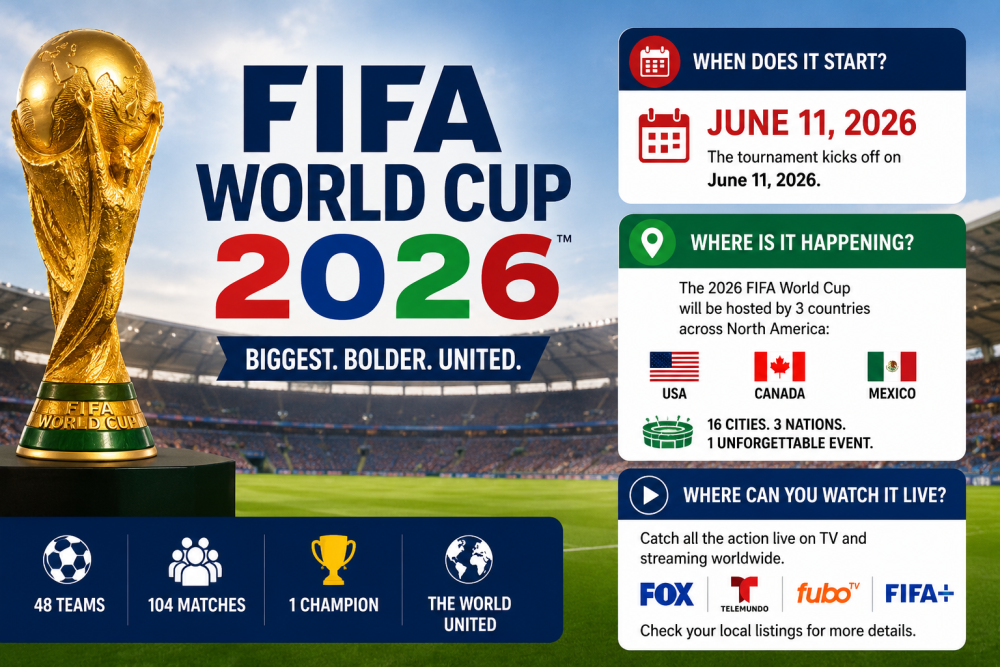
Let me save you some scrolling. The tournament kicked off on June 11, 2026. Mexico opened it at the Azteca in Mexico City, and the whole thing wraps up with the final on July 19 at MetLife Stadium outside New York. Thirty-nine days end to end, which no World Cup has ever done before.
Still here? Good, because the date is honestly the least interesting part. This tournament is a strange, sprawling beast compared to every edition that came before it, and following it properly takes a bit of homework. Three countries are hosting at once. Forty-eight teams made it in. There are 104 matches, which is so many that I gave up trying to watch them all somewhere around the second week, and I write about this stuff for a living.
And then there's the question that fills my inbox more than any other: what channel is it actually on? The answer changes completely depending on which country you're sitting in, so I've broken it all down below.
The Dates Worth Writing Down
The group stage came and went between June 11 and June 27. Twelve groups this time, not eight, which took some getting used to.
Here's where newcomers get lost. There's an extra knockout round now. Because 48 teams produce 32 qualifiers rather than 16, FIFA bolted on a Round of 32 that ran June 28 through July 3. Then the Round of 16 is from the 4th to the 7th of July, the same as the old days, just arriving a week later than your brain expects.
From there the calendar opens up. Quarter-finals go July 9 to 11. The semis are on the 14th and 15th, split between Dallas and Atlanta. On the 18th there's the third-place game, a fixture I've defended at dinner parties and lost every time, and then Sunday the 19th is the big one.
For the record, the hosts all got going early. Mexico had opening night to themselves on the 11th, then Canada played in Toronto and the US played at SoFi in Los Angeles the following day.
Oh, and a bit of trivia from that opening match that I love. The Azteca is now the only stadium on earth to have staged games at three different World Cups. It did in 1970, when Pele's Brazil ran riot, then 1986, which was Maradona's tournament, and now this one. The concourses are cramped, and the concrete is showing its age, but you can't manufacture that kind of history.
So Why Is Everything Bigger This Time?
Simple version: for over two decades, a World Cup meant 32 teams and 64 games. FIFA tore that up. Forty-eight teams. A hundred and four matches. Do the math, and that's roughly 60 percent more football than Qatar served up four years ago.
Was it a cash grab? Partly, sure. But I'll admit the expanded format has grown on me. The top two in each of the twelve groups advance, plus the eight best third-place finishers, and that last detail changes everything. Teams that would've been packing their bags after two defeats in the old format were still fighting on the final matchday. Almost nothing was dead rubber.
There's a physical cost, though. The team that lifts the trophy will have played eight matches instead of seven, across five weeks, in the thick of a North American summer. Watch how the smart managers rotate. Depth wins this one, not just talent.
The Venues, Briefly
Sixteen cities, three countries, and distances that make previous tournaments look like village fetes. Vancouver to Mexico City is nearly 4,000 kilometers. In Qatar you could genuinely attend two matches in a single day. Try that here and you'd better own a plane.
America has the lion's share with eleven grounds, and once the quarter-finals start, every remaining match is on US soil. The roll call: MetLife in New Jersey gets the final; SoFi in LA; the giant AT&T Stadium in Dallas (more matches there than anywhere else); Atlanta's Mercedes-Benz; Houston's NRG; Hard Rock in Miami; the Linc in Philadelphia; Lumen Field up in Seattle; Levi's near San Francisco; Gillette outside Boston; and Arrowhead in Kansas City, which might be the loudest of the lot.
Canada brought two venues to the party, BMO Field in Toronto and BC Place in Vancouver. Mexico has three: the Azteca, the Akron in Guadalajara, and Monterrey's steel-and-glass Estadio BBVA, which sits under a mountain and looks fantastic on television.
Right, Where Do You Actually Watch This Thing?
The bit you came for. TV rights get sold country by country, so I'll take the four markets our readers ask about most, one at a time.
If you're in the United States
Your situation depends on your language preference, oddly enough.
Watching in English means FOX. Games are spread across the main FOX channel and FS1, with the biggest fixtures, the final included, on the flagship network. Cable subscribers don't need to do anything. Cord-cutters have a handful of routes: the FOX Sports app works if you can borrow someone's TV login; Fubo carries both channels and hands out free trials (start one in early July and you've covered the entire knockout stage, just saying); and the usual suspects like YouTube TV, Hulu Live, Sling, and DirecTV Stream all do the job too.
Watching in Spanish means Telemundo, and here's the trick savvy fans figured out ages ago: every match, all 104, streams live on Peacock. A month of Peacock costs less than parking at any of these stadiums. Half the bilingual fans I know pick the Spanish feed even when English is available, because a Telemundo goal call is an experience in itself.
My cheapskate special for American readers: a $20 antenna pulls in the Fox network games free; Peacock mops up the rest. Whole tournament, barely any money spent.
If you're in Canada
Everything runs through Bell Media. TSN and CTV carry the English coverage, with CTV, free over the air in most of the country, getting all the Canadian matches and the final. Quebec and French speakers elsewhere have RDS. Streaming goes through the TSN app or TSN+ if you subscribe.
I don't need to tell Canadians how big this is. The men have never played a World Cup at home before. The scenes in Toronto after that opening match will be replayed for decades.
If you're in the UK
You lucky people. Not a penny to pay. The BBC and ITV carved up the fixtures between them like they always do; both get the final, and iPlayer and ITVX stream everything with a standard TV license.
Your enemy is the clock, not the cost. North American evening kickoffs land at 1am, 2am, and sometimes 3am British time once the West Coast games roll around. I've done a few of those all-nighters this tournament already, and my advice has crystallized: save them for matches you'd regret missing live, and for everything else, swerve the group chat and the radio next morning and watch the replay over breakfast. Both iPlayer and ITVX post full matches almost the moment the whistle blows.
If you're in the Middle East
One word: beIN. Same as every FIFA tournament in recent memory, beIN Sports has the whole region covered, all 104 games, with commentary in Arabic and English. On the streaming side it's the beIN Sports Connect app or TOD, their standalone platform.
The Gulf actually gets friendlier hours than Britain for a decent chunk of the schedule. An afternoon game on the American East Coast reaches Dubai and Riyadh at around 11 at night, which is very doable. The late American kickoffs are 4am territory, though, so the replay strategy applies there just the same.
A Word on Kick-Off Times
Even after weeks of this I still occasionally get caught out, so here's my rough guide.
The schedule is built around US Eastern Time, which makes the American East Coast the sweet spot. West Coast fans have had some cruel 9am starts. British viewers add five hours to Eastern kick-offs (so 3pm Eastern is a pleasant 8pm pint-in-hand affair, while 9pm Eastern is a grim 2am one). Gulf viewers add eight, putting that same 3pm Eastern game at 11pm locally.
Things I'd Tell a Friend Before the Knockouts
Don't attempt the full 104. Nobody's marriage survives that. Pick your team's games, a couple of heavyweight collisions a week, and then go all-in from the quarters onward when every match matters.
Pay for a legal stream or use a free legitimate one. Yes, dodgy streams exist. They also freeze the instant someone steps up for a penalty; every single time, it's practically a law of nature. Each country above has at least one cheap or free proper option.
Sort your Wi-Fi now. HD wants a solid 5 Mbps, 4K wants 25+, and if the whole house is streaming different things during a semifinal, run a cable to the main TV. Future you says thanks.
Embrace replays. They go up within an hour or two on every platform mentioned here. A spoiler-free morning replay with coffee is about 90 percent as good as live and 100 percent better for your sleep.
Quick-Fire Questions
When did it start? June 11, 2026, at the Azteca. The group stage finished on the 27th; knockouts run through July.
When's the final? Sunday, July 19, MetLife Stadium, New Jersey. Eighty-two thousand seats, all long since sold.
How many teams? Forty-eight, playing 104 games. Both figures are records, and whoever wins will have played eight matches to do it.
Can I watch for free? Brits, yes, all of it, on BBC and ITV. Canadians get the CTV games free over the air. Americans can pull FOX network games off an antenna for nothing, though FS1 fixtures need some kind of subscription, and Peacock's cheap Spanish-language feed covers everything.
Arabic coverage? beIN Sports, across the Middle East and North Africa, plus their TOD and beIN Connect streaming apps.
Has a World Cup ever had three hosts? Never before this one. Japan and South Korea sharing 2002 was the only previous co-hosting, and that was just two.
Last Thing
I keep coming back to 1994. That was the last time this tournament came to North America, and an entire generation over here traces their love of the game to that summer. Thirty-two years later it's back, swollen to a size nobody quite imagined, and spread from the Pacific Northwest down to Mexico City.
It started June 11. It ends July 19. FOX and Telemundo have it in the States, TSN and CTV up in Canada, and the Beeb and ITV in Britain and beIN across the Arab world. Sort your channels, guard your sleep schedule where you can, and enjoy what's left of it. Something this size might genuinely never happen again.