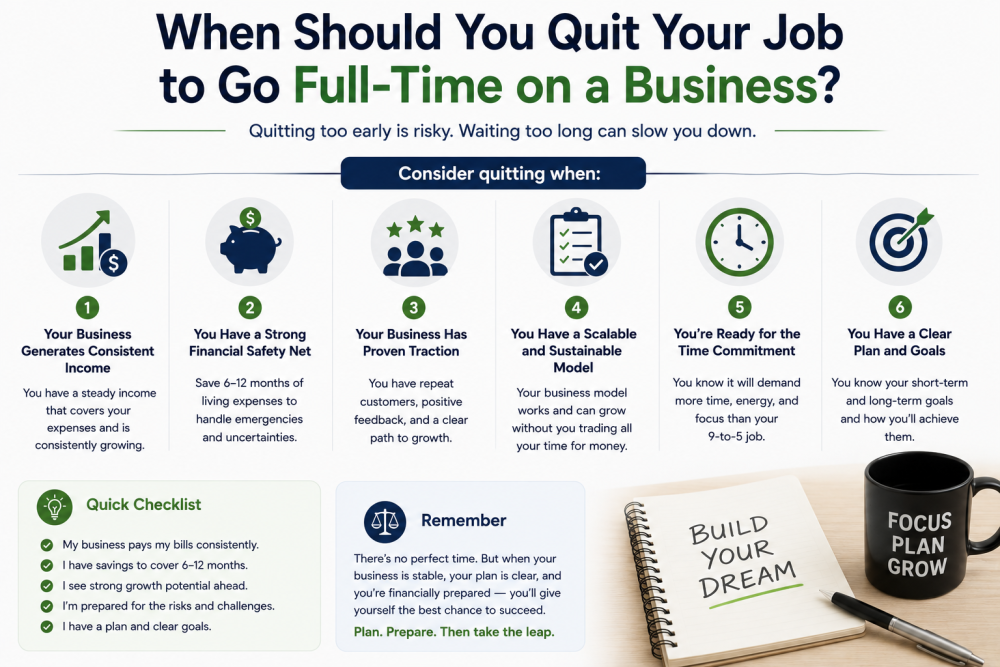
The internet has two answers to this question and both are wrong. The hustle-culture answer, "burn the boats, the fear will motivate you," has bankrupted more good businesses than any recession, because desperation makes terrible decisions and clients can smell it. The forever-cautious answer, "wait until it's completely safe," is a polite way of saying never, because complete safety doesn't exist in self-employment and waiting for it is just fear wearing a spreadsheet.
The real answer is a set of gates, financial, demand-side, and personal, and when they're open, the leap stops being brave and becomes merely correct, which is exactly how it should feel. This article is the gates: the runway math, the income benchmarks that actually mean something, the single demand signal that outranks everything else, the bridge strategies that make the whole question less binary, and the honest section on what quitting doesn't fix.
Standing line, sincerely: general information, not financial advice, and a decision this size, with your specific obligations, family, and country's safety nets in the mix, deserves your numbers run properly, ideally with a professional glance over them.
Gate One: The Runway
Runway is the money that buys you time to be wrong, and it's the first gate because everything else in self-employment goes better when you're not desperate.
The working benchmark: six to twelve months of essential expenses, the survival-month figure from our emergency fund guide, not the lifestyle month, saved and earmarked for the transition, and here's the part people miss, that runway sits on top of the emergency fund, not instead of it. The emergency fund handles emergencies; the runway funds the plan. Merge them and the first surprise expense eats the business's oxygen. Freelancers and variable-income folk lean toward the twelve-month end for the same reasons our fund guide gives them bigger targets generally: your income gaps and your emergencies like to carpool.
And build the runway honestly, which means the full self-employment math: the benefits your job quietly pays for, health cover where that's a private cost, pension contributions, paid leave, get repriced onto your side of the ledger, and the tax reality from our side hustle coverage, roughly a quarter to a third of self-employed income was never yours, applies from day one. The salary you're replacing is bigger than the number on the payslip. Price the whole thing.
Gate Two: The Income Trend, Not the Spike
One great month proves nothing except that one great month is possible; the leap runs on trends. The benchmark that repeats across everyone who's done this well: the business consistently covering a substantial share of your essential expenses, somewhere in the half-to-three-quarters range, for at least six months running, while you're still employed, meaning it's doing that on your part-time scraps of evenings and weekends.
That last clause is the whole logic of the benchmark: a business earning 60 percent of your needs on fifteen hours a week has obvious headroom when forty hours arrive. A business earning 100 percent in one lucky month and 20 percent the other five doesn't have headroom, it has variance, and variance is exactly what the runway exists to survive, not what the decision should be built on. Chart the monthly trend for six months. The chart votes. Spikes don't.
Gate Three: The Demand Signal That Outranks Everything
Here's the green light experienced founders trust above every spreadsheet: you're turning away work. Declining projects for lack of hours, running a waitlist, quoting longer lead times and watching clients wait anyway, the "booked solid and everyone says yes" condition our pricing guide flags as the underpricing signal is, simultaneously, the quitting signal, because it's proof the constraint on the business is your employed hours and nothing else.
This matters because it answers the question the leap actually asks: will more hours become more income? Turning away demand: yes, demonstrably, the demand is already there, unserved. No waitlist, no declined work, calendar gaps at fifteen hours a week: then more hours mostly become more waiting, and the honest priority isn't quitting, it's the client-getting machinery from our growth and business guides, built on evenings, until the constraint genuinely is your day job. Quit to serve demand you have. Never quit to go find demand you hope for.
The Bridges: Because It Isn't Actually Binary
The quit-or-stay framing is a false binary, and the middle options de-risk the whole thing. Dropping to part-time or compressed hours, where your job and country allow it, is the classic: income floor intact, twenty extra business hours found, and the trend data from Gate Two accelerates. Unpaid leave or a sabbatical buys a clean 90-day experiment with a return ticket. A household income season, one partner's salary steadying the ship during the transition, is how a huge share of successful leaps actually happened behind the origin stories. And negotiating contractor status with your current employer, becoming their vendor instead of their employee, is the underrated jackpot: first anchor client, day one, sometimes at better effective rates.
None of the bridges are glamorous, and all of them beat the cliff. The founders who "risked everything" in the retellings mostly, on inspection, bridged.
What Quitting Doesn't Fix
The honest section, because the leap carries a myth that costs people years: quitting doesn't fix a business's problems, it funds them with your savings. Weak demand doesn't strengthen because you're available more, wrong pricing doesn't correct because you need it to, per the pricing guide it usually gets worse under desperation, and a business that only works with hustle-culture hours isn't a business yet, it's a job with worse benefits that you own.
Related, and worth saying plainly: hating your job is not a business plan. The push of a bad job and the pull of a working business feel identical from inside a bad week and lead to completely different places, one to freedom, the other to unemployment with a hobby attached. Run the gates precisely because feelings this strong deserve arithmetic this cold. If the gates are open AND you hate your job, wonderful, enjoy the resignation letter, it's earned. If only the hate is present, the gates just saved you.
The Leap Itself: A Short Checklist
When the gates open, the transition week's list is mercifully short: pipeline booked, ideally two-plus months of committed work before the last payday, the legal and tax housekeeping from our business legal guide current, structure, registrations, the tax percentage auto-parked, insurance sorted, the health and liability cover your situation requires priced and bound before the employer versions lapse, runway untouched in its own account per the fund guide's mechanics, and a 90-day plan that schedules the newly free hours like the valuable inventory they are, because the first surprise of full-time is how fast unstructured hours evaporate. Then the actual resignation, professionally, bridges unburned, per the contractor-jackpot note above, today's employer is tomorrow's best client more often than pride expects.
The Bottom Line
Quit when the gates are open: six to twelve months of true runway sitting on top of an intact emergency fund, the business covering half to three-quarters of essential expenses for six consistent months on part-time hours, and, above all, demand you're demonstrably turning away, the proof that your employed hours are the last constraint. Use the bridges, part-time, leave, the household season, the contractor conversion, to make the question smaller, and never let hating the job impersonate the business being ready.
Done this way, the leap isn't a leap at all, it's a step off a curb you spent a year lowering, and the fear that remains is just the normal price of working for yourself. That one, you'll find, is worth paying.
FAQs: Quitting Your Job for Your Business
How much money should I save before quitting my job for my business?
Six to twelve months of essential expenses as dedicated runway, on top of an intact emergency fund, not merged with it, with the longer end for variable-income work. Price the runway honestly: include the benefits your job currently covers and the quarter-to-third of self-employed income that goes to tax, because the salary you're replacing is bigger than the payslip number.
How much should my business earn before I go full-time?
The benchmark with the best track record: consistently covering roughly half to three-quarters of your essential expenses for six-plus months, earned on part-time hours while still employed. That combination proves both demand and headroom, full-time hours have somewhere real to go, whereas one great month proves only variance, which is what runway is for, not what decisions are built on.
What's the clearest sign it's time to quit and go full-time?
Turning away work: declined projects, a waitlist, clients accepting longer lead times. It's the one signal that directly answers the leap's real question, will more hours become more income, with evidence rather than hope. Absent that signal, the better move is building demand on evenings until your job genuinely becomes the constraint.
Should I quit my job if I hate it, to force myself to succeed?
No, and this myth has expensive alumni: desperation degrades pricing, sales, and judgment, and a business's weaknesses get funded by your savings rather than fixed by your availability. Hating the job and the business being ready are separate facts that feel similar; run the financial and demand gates precisely because the feeling is strong, and let the arithmetic cast the deciding vote.
Is it better to go part-time before quitting completely?
Usually, where the job and jurisdiction allow it: reduced hours keep an income floor while roughly doubling business time, accelerating exactly the trend data the decision needs. The other bridges, unpaid leave as a 90-day trial, a household-income season, or converting your employer into your first client as a contractor, all beat the binary cliff, and most successful leaps used one.
What should be ready before my last day of employment?
A booked pipeline of committed work, ideally two-plus months; the legal and tax housekeeping current, structure, registrations, and the tax slice auto-saved; replacement insurance, health where private and liability for the work, bound before employer cover lapses; the runway parked untouched in its own account; and a scheduled 90-day plan for the new hours. Then resign well: today's employer is tomorrow's anchor client surprisingly often.