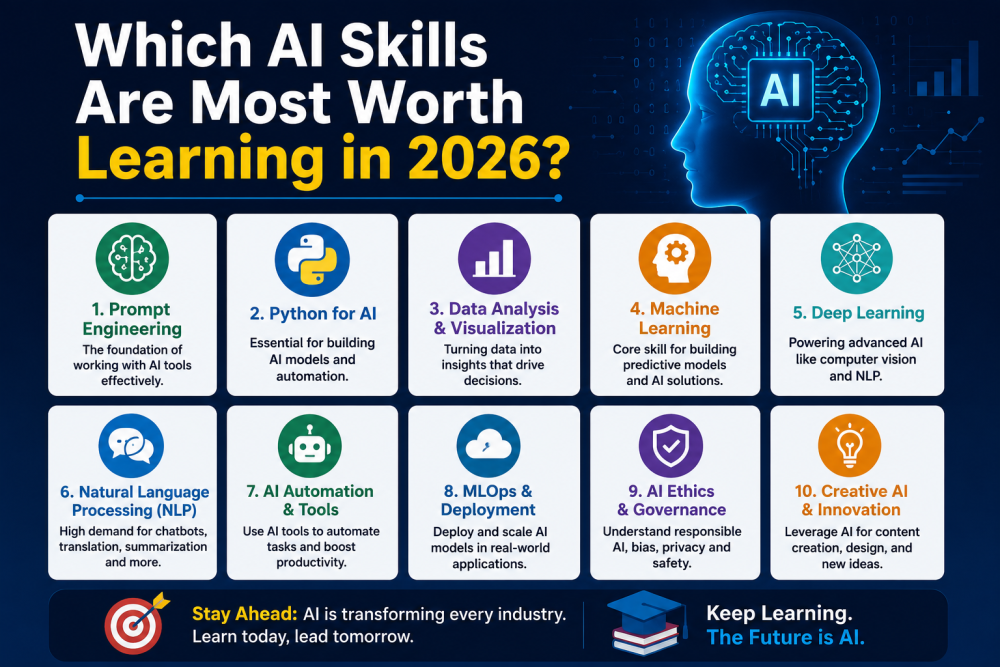
The most valuable AI skill in 2026 isn't coding, isn't "prompt engineering," and isn't anything with a certificate attached. It's the unglamorous ability to fold AI into the work you already do well, and the people cashing the biggest checks from this technology are mostly not AI specialists. They're accountants, marketers, recruiters, and shop owners who became the AI-fluent version of themselves eighteen months before their colleagues bothered.
That's the thesis, and this article defends it with a ranked list: the skills genuinely worth your hours this year, what each one actually is beneath the buzzword crust, how long it honestly takes, and where the free learning lives. Plus the anti-list, the skills the course-sellers are loudly renting out that the market has quietly stopped buying, because half of "learning AI" in 2026 is knowing what to skip.
Skill One: Workflow Fluency, the Multiplier
The foundation, and for most readers, most of the value. Workflow fluency means knowing, from practice rather than headlines, which parts of your actual job an AI assistant does well, which parts it botches, and how to hand work back and forth with it fast: drafting, summarizing, analyzing, brainstorming, and reformatting, the connective tissue of every desk job.
What it isn't: memorizing magic prompts. The models in 2026 are good enough that clear instructions in plain language beat incantations, and the real skill is the same one that makes someone good at delegating to a junior colleague specific tasks, context provided, and output reviewed. Which is why "prompt engineering" as a standalone career has largely evaporated back into everyone's job description, the way "computer skills" did a generation ago. Learn it as a layer, not a destination.
Honest time cost: two to four weeks of deliberately using an assistant on your real work, not tutorials; your actual Tuesday; and the learning is free, and the practice is the course. Our guide to writing with AI walks the deepest version of this for content work, and the pattern transfers to every profession.
Skill Two: Agent and Automation Building, No Code Required
The step past chatting: making AI do things while you're elsewhere. In 2026 this means the no-code layer, wiring an assistant into email, calendars, sheets, and store platforms, and building the "when this happens, do that, flag anything weird" workflows that used to need a developer and now need an afternoon and a Zapier-class tool.
This is the skill with the widest gap between how easy it's become and how few people have it, which is exactly the description of a valuable skill. For freelancers and small business operators it converts directly to hours and money; we've covered the business case in our AI agents guide, and for employees it's the difference between "uses ChatGPT" and "automated a process the whole team hated," which is a promotion sentence.
Time cost: a weekend to build your first real automation and a couple of months of tinkering to genuine competence. Free tiers of the automation platforms are the classroom.
Skill Three: Verification Judgment, the Trust Skill
The quiet one is increasingly the differentiator. AI output arrives fluent, confident, and intermittently wrong, and the professional who can rapidly tell which is which, who knows where models hallucinate, what always needs a source, and when the confident answer smells off is worth more every year that AI produces more of the world's first drafts.
This skill is really two habits: knowing the failure patterns (invented citations, plausible numbers, outdated facts stated as current, and agreement with your own framing) and owning a verification routine proportional to stakes (skim-check for low stakes, source-check for anything published, and expert-check for anything expensive). It compounds with domain expertise: the accountant catches the AI's tax error that the generalist ships, which is the whole reason deep knowledge of your field got more valuable in the AI era, not less. The machine made first drafts cheap. It made knowing-when-the-draft-is-wrong precious.
Time cost: ongoing, built by using AI on work where you can check the answers, and accelerated by keeping a small private log of every error you catch. Three months of that log teaches more than any course sold on the subject.
Skill Four: The Technical Layer, for Those Who Want It
For the minority who should go deeper, and it is a minority, the technical stack worth learning in 2026, in ascending order of commitment: calling AI models through APIs (a competent beginner programmer's weekend, and it unlocks building real tools); the retrieval pattern everyone calls RAG (connecting models to your own documents and data, the architecture behind most useful business AI); and fine-tuning awareness, knowing when custom training is worth it, which, for most small operations, is "later, if ever."
The honest filter for whether this layer is for you: you want to build products, you're already technical, or your role touches data and systems. If none of those, skills one through three capture most of the value at a tenth of the effort, and there's no prize for suffering through Python because a LinkedIn post shamed you.
Skill Five: The Human Moat
The anti-AI skills, which the AI era pays better for, not worse. Judgment and taste: knowing which of the five drafts is good and which idea is worth pursuing, since generation got cheap and selection didn't. Client trust and relationships, the part of every service business that was never about the deliverable. Domain depth, per skill three. And communication—the irony of the decade being that clear thinking expressed clearly became more valuable when machines started producing infinite mediocre text.
These don't feel like "AI skills," and that's the point: the market pays for the combination, the person with the craft and the fluency, and either half alone is increasingly a discounted product.
The Anti-List: What to Skip in 2026
Equal time for the money-savers. Prompt-engineering certificates and $500-plus "AI mastery" courses: the content is free everywhere, and the certificate signals nothing to anyone hiring. Tool of the week: Chasing and learning the fundamentals of one assistant deeply transfers; collecting logins does not. Learning to code purely because AI exists, either you have a builder's itch or you don't, and skill two gets non-coders most of the leverage. And for "AI influencer" as a skill path, the market for people explaining AI badly reached saturation sometime in 2024 and never recovered.
The pattern across the whole anti-list: anything sold with urgency, buy now, falling behind, or last chance is priced on your fear rather than its value. Real AI skills are learned on free tiers with real work, at the speed of practice.
The Bottom Line
The AI skills worth your 2026, ranked: workflow fluency with the assistants on your actual job, first and foremost. Agent and automation building on the no-code platforms are the biggest current gap between ease and adoption. Verification judgment, the trust skill that appreciates yearly. The technical API-and-RAG layer for the builder minority. And the human moat, judgment, relationships, and domain depth, which the whole stack quietly multiplies rather than replaces.
Learn on free tiers, practice on real work, log the errors you catch, skip everything sold with a countdown timer, and give it a season of consistency. The colleagues who did this in the last two years aren't visibly "AI people." They're just faster, and that, not the certificate, was always the job market's actual currency.
FAQs: Learning AI Skills
What is the best AI skill to learn first in 2026?
Workflow fluency: using a mainstream assistant on your real daily work until you know precisely what it does well and badly for your job. It's free, takes weeks rather than months, and multiplies whatever profession you already have, which beats learning any specialist skill in a vacuum.
Is prompt engineering still a career in 2026?
As a standalone job title, it has largely dissolved back into everyone's role, the way "computer skills" stopped being a career and became an expectation. Clear, specific instruction-giving remains genuinely valuable, but as a layer on real work, paying for prompt-engineering certificates in 2026 buys signaling that hiring managers stopped reading.
Do I need to learn coding for AI?
Only if you want to build products or you're already technical. The no-code automation layer captures most of the practical leverage for everyone else; wiring assistants into email, sheets, and business tools takes an afternoon, not a computer science course. Code unlocks the deeper layer (APIs, retrieval systems) for the minority whose goals need it.
How long does it take to become good with AI tools?
Honest ranges: two to four weeks of daily use for solid workflow fluency; a weekend for a first real automation and a couple of months to build them confidently; and an ongoing practice for verification judgment, which grows with every error you catch and log. None of it requires paid courses; all of it requires using the tools on real work rather than on tutorials.
Which AI skills will matter most for jobs in the next few years?
The combination pattern: your existing domain expertise plus fluency, automation, and verification. Employers increasingly assume assistants use the way they assume email and pay the premium for people who automate processes and can be trusted to catch AI's confident errors, judgment being the skill that is appreciated as generated output gets cheaper.
Are paid AI courses worth it in 2026?
Rarely at the beginner and intermediate level, where free documentation, free tiers, and practice on your own work outteach almost everything sold. The exceptions are narrow: genuine technical training for builders or employer-paid structured programs. The reliable filter: anything marketed with urgency and income promises is selling the fear, not the skill.