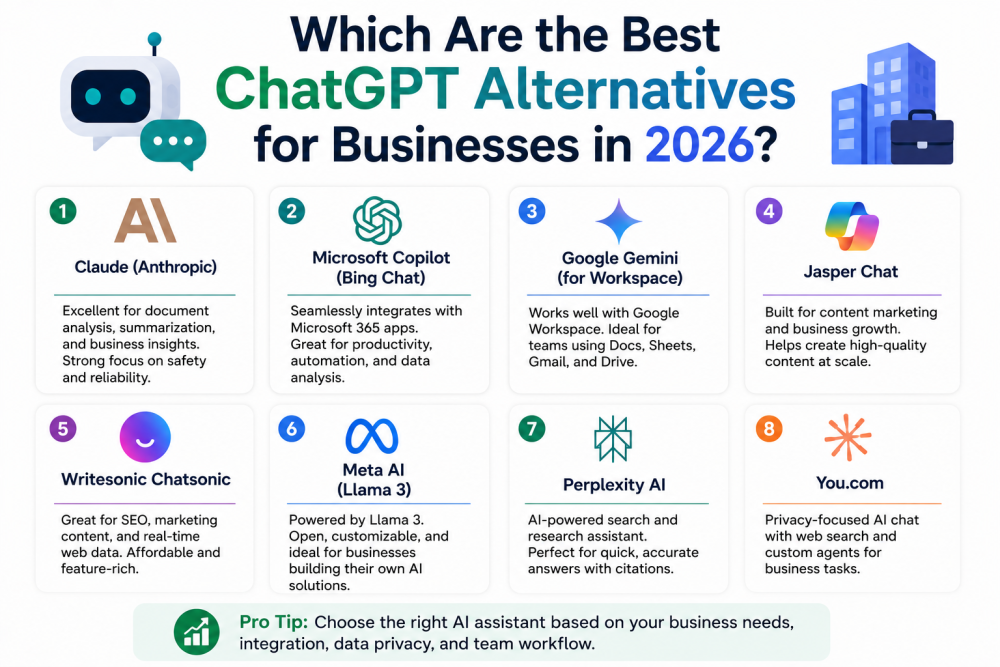
Five names cover the serious answers: Claude, Google's Gemini, Microsoft Copilot, Meta's Llama family for the self-hosting crowd, and Perplexity for the research-heavy corner of your team. Which one is "best" depends almost entirely on a question most comparison articles skip, which is: what does your business already run on, and what happens to your data?
That second question is the whole game for businesses in 2026, so this article is organized around fit rather than a horse race. And a disclosure before anything else, because it would be strange not to make it: parts of this article's drafting workflow ran through Claude, one of the tools being compared. I've tried to be even-handed, the final judgments are the site's own, and you should weigh that context as you read, the same way you'd weigh any reviewer's toolkit.
One more caveat, sincerely meant. This market reshuffles faster than any category we cover, models leapfrog each other every few months and pricing shifts with them, so treat the landscape below as accurate to early 2026 and verify current versions and prices on the official sites before signing anything annual.
First, Why Leave ChatGPT at All?
Because ChatGPT is genuinely good, let's start there, and for many businesses the status quo is fine. The reasons companies shop around cluster into four:
Ecosystem gravity. If your company lives in Google Workspace or Microsoft 365, an assistant woven into your actual email, documents, and spreadsheets often beats a better model in a separate tab.
Data governance. Boards and legal teams now ask pointed questions about where prompts go, what gets retained, and what trains future models. Different vendors answer differently, and some businesses in regulated industries end up choosing self-hosted models for exactly this reason.
Specific strengths. The frontier models have personalities and specialties, one drafts long documents better, another integrates search better, another codes better this quarter, and a team that writes all day has different needs than a team that analyzes spreadsheets all day.
And cost, at scale. Per-seat prices look similar until you multiply by 200 employees, and API prices vary enormously for high-volume automation.
If none of those four pinch you, close this tab with my blessing. If one does, here's the field.
Claude: The Writing and Documents Pick
Anthropic's Claude has built its business reputation on long-form work: drafting and editing that holds a consistent voice, digesting big documents, contracts, reports, research piles, and reasoning through them carefully, and a generally lower appetite for making things up than the category average, though no model, none, is hallucination-free, and your review step stays mandatory everywhere.
Businesses tend to pick Claude when the work is document-heavy: legal and consulting shops, marketing and content teams, anyone whose day is reading and writing at length. Team plans exist alongside a widely used API, and recent versions added the agent-style abilities the whole frontier is racing toward, taking multi-step actions rather than just chatting. Weaknesses, honestly stated: the surrounding ecosystem is thinner than Google's or Microsoft's, so it's a destination tool rather than something living inside your inbox.
Gemini: The Pick if You Live in Google
Google's play is less "better chatbot" and more "the assistant is already inside everything you use." Gemini drafts in Gmail, summarizes in Docs, builds formulas in Sheets, and recaps Meet calls, and for Workspace-based companies that integration frequently beats raw model quality comparisons, because nobody has to change how they work. The underlying models are firmly frontier-class, with particularly long context windows for feeding in large materials, and Google bundles Gemini into Workspace business tiers, which makes the pricing math friendly for companies already paying for Workspace.
The catch mirrors the strength: Gemini's value concentrates inside Google's world. If your company runs on Microsoft, look next door.
Microsoft Copilot: The Pick if You Live in Office
Copilot is the same integration thesis aimed at the other half of the corporate world: Word, Excel, Outlook, Teams, PowerPoint, with OpenAI's models doing much of the heavy lifting underneath, which makes Copilot the quiet answer for businesses that want ChatGPT-class ability wrapped in Microsoft's enterprise controls, compliance stack, and admin tooling. IT departments in particular tend to exhale around Copilot, because it inherits the Microsoft 365 governance they already trust.
Real-world reviews are more mixed feature-to-feature than the marketing suggests, some integrations shine, Excel and Teams especially, others still feel bolted on, so pilot it with real work before a company-wide rollout. Per-seat pricing on top of 365 licensing is how it arrives.
Llama and the Open-Source Route: The Control Pick
Meta's Llama models headline a different philosophy entirely: run the model yourself, or through a cloud provider you already trust, and your data never leaves your walls. For banks, healthcare, government-adjacent work, and anyone whose lawyers frown at third-party AI processing, this is often the only acceptable route, and the open-weight models of 2026, Llama's latest generations, Mistral's efficient European offerings, and others, have closed enough of the quality gap to do real business work.
The honest trade: you're buying control with engineering effort. Self-hosting needs infrastructure and people, though managed versions through the big clouds soften that considerably. Mistral deserves a specific mention for European businesses, where an EU-based vendor simplifies certain compliance conversations before they start.
Perplexity: The Research Specialist
Different animal, worth knowing. Perplexity is an answer engine, every response built on live web search with citations attached, which makes it the tool for the parts of your business that ask "what's the current state of X" all day: market research, competitive intelligence, due diligence prep. It's a complement more often than a replacement, plenty of teams run it alongside a general assistant, but for research-heavy roles it earns its seat.
The Choosing Framework, Compressed
Strip the branding away and the decision is usually over in four questions. Where does your company live? Google shops start with Gemini, Microsoft shops start with Copilot, and the integration advantage is real. Is the work document-and-writing heavy? Trial Claude against your incumbent on your actual documents, a week settles it. Do regulators or lawyers shape your IT decisions? Price out the open-source route seriously, Llama or Mistral, self-hosted or via your existing cloud. Is research the bottleneck? Add Perplexity for those seats rather than switching everyone.
And whatever you trial, trial with real work, your contracts, your spreadsheets, your customer emails, for two weeks, with the people who'd use it daily. Demo benchmarks are marketing; your Tuesday afternoon workload is the truth.
The Bottom Line
The best ChatGPT alternative for a business in 2026 is rarely about which model tops this month's leaderboard. Gemini wins inside Google companies, Copilot wins inside Microsoft companies, Claude wins where the work is long documents and careful writing, open-source Llama and Mistral win where data control is non-negotiable, and Perplexity wins the research desk. The models leapfrog each other quarterly; the fit questions barely move.
Answer the fit questions, run a two-week trial on genuine work, and hold whatever you choose to the same rule that applies to every tool in this category: it drafts, a human decides. That rule outlasts every version number.
FAQs: ChatGPT Alternatives for Business
What is the best ChatGPT alternative for most businesses?
For companies on Google Workspace, Gemini, and for companies on Microsoft 365, Copilot, because assistant-inside-your-tools consistently beats a marginally better model in a separate tab for everyday work. Claude leads for document-heavy and writing-heavy teams, and open-source models lead where data can't leave the building.
Is Claude better than ChatGPT for business use?
For long-form writing, editing in a consistent voice, and working through large documents, Claude has earned that reputation, with the disclosure that this article's workflow used Claude, so test rather than take our word. For other workloads the two trade blows version by version, which is why a two-week trial on your own real documents beats any comparison article, including this one.
What's the cheapest way to give a whole team AI tools?
If you already pay for Google Workspace or Microsoft 365, the bundled or add-on assistant is usually the best per-seat math. Beyond that, most vendors' team tiers cluster in a similar per-user range, so the bigger cost lever is scoping: giving full seats to the heavy users and lighter or shared access elsewhere, rather than blanket-licensing everyone on day one.
Are open-source models like Llama good enough for real business work?
In 2026, yes, for a wide range of tasks, the latest open-weight generations handle drafting, summarizing, and analysis at a level that would have been frontier-class not long ago. The trade is operational: you or a managed provider run the infrastructure. Businesses choose this route mainly for data control and compliance, with cost at scale as the secondary draw.
Can I use more than one AI assistant in the same business?
Not only can you, most sophisticated setups do: an integrated assistant (Gemini or Copilot) for everyone inside the office suite, a specialist like Claude for the writing-heavy team, Perplexity seats for research roles, and an API model behind any automated workflows. The single-vendor-for-everything instinct usually costs more capability than it saves in simplicity.
How do I know my business data is safe with these tools?
Read the business tier's data terms specifically, not the consumer ones: the questions that matter are whether your prompts train future models, how long data is retained, and where it's processed. Major vendors' business plans generally exclude training on your data, but guarantees vary, and regulated industries often need the contractual specifics or the self-hosted route. Make legal read the data processing agreement before the rollout, not after.