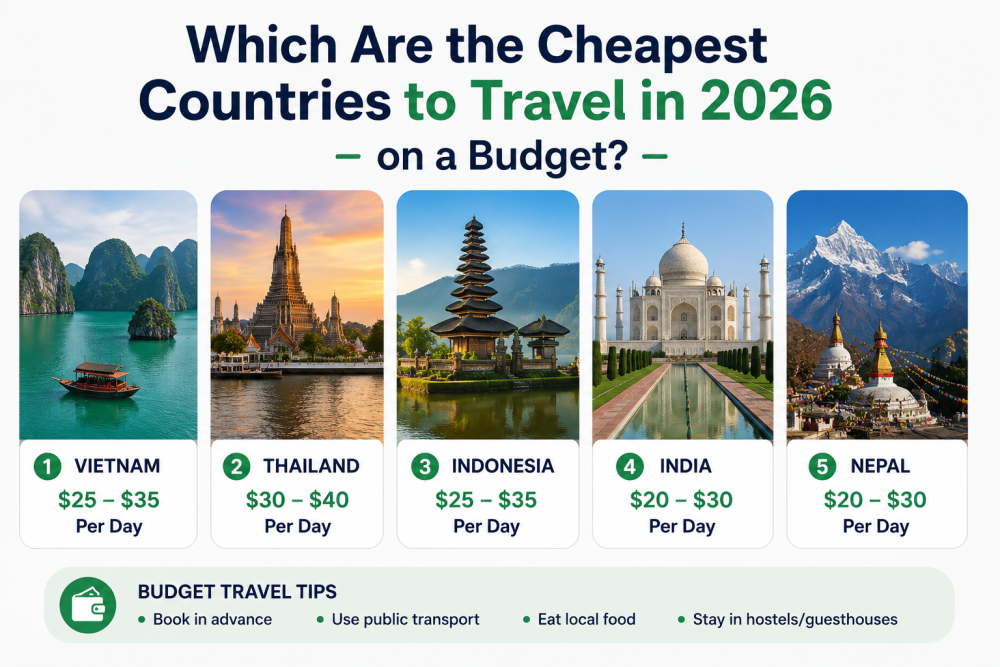
Shortlist first, details after. Vietnam. India. Sri Lanka. Indonesia if you dodge the expensive corners of Bali. Georgia and Albania are for anyone who wants Europe-ish without European bills. Egypt. And for North Americans who'd rather not blow $900 on the flight alone, there's Mexico and Colombia. Depending on the country, you're looking at somewhere between $25 and $50 a day, done comfortably.
There. That's the answer most articles bury under two thousand words of throat-clearing.
But stay with me, because the country list is honestly the less important half of this. I've met people who burned through more money in "cheap" Thailand than my friends spent in Switzerland the same month, and I wish I were exaggerating. Where you go matters. How you travel once you're there matters more. This guide covers both with actual numbers, and I'll flag where those numbers are shaky.
Speaking of which. Prices drift. Currencies do strange things, especially in a couple of the countries below, and a figure that held in spring can look optimistic by autumn. Everything here is a good-faith 2026 planning estimate. Double-check closer to your dates, and don't email me if PHO has gone up forty cents.
What Kind of Trip Are We Pricing, Exactly?
Not luxury. Not misery either.
The budgets in this article assume guesthouses, hostels, or cheap hotels; food from the places locals actually eat with a nicer meal thrown in now and then; buses and ride-hailing apps instead of private drivers; and a few paid activities each week. It's the slightly scrappy style of travel that, in my experience, people end up preferring to the resort version anyway. You remember the night market. Nobody remembers the hotel buffet.
Flights aren't included in any daily figure. They deserve their own section, and they get one near the end, because for readers flying out of the US, Canada, the UK, or the Gulf, the plane ticket is usually the biggest single line on the whole trip.
Vietnam, Because Obviously
Every budget travel list starts here, and there's a reason nobody's dethroned it.
Twenty-five to thirty-five dollars a day. That's a private guesthouse room, three real meals, and getting around. Pho from a street stall costs a dollar and change and will ruin restaurant pho for you forever. A banh mi, often less than that. When I priced out an overnight sleeper bus running half the length of the country, it came to less than what an airport taxi costs at home.
Here's what makes Vietnam special, though, beyond raw cheapness. The cheap choice is usually the best choice. Street food beats the fancy places. The rented motorbike beats the tour bus. Ha Giang's mountain loop in the north, lantern-lit Hoi An, and the Mekong's floating markets. None of it asks much of your wallet.
The Subcontinent: India and Sri Lanka
Nothing on this planet stretches money like India. Twenty to thirty dollars a day, and careful travelers go lower. That covers train rides across distances that would span four European countries, dollar meals, and rooms for a few dollars more.
The catch isn't financial. India is loud, intense, and gloriously overwhelming, and it takes energy that first-time backpackers don't always have to give. I love it. I also wouldn't send a nervous first-timer there alone, and I say that with affection.
Sri Lanka is the gentler cousin. Beaches, hill-country tea towns, ancient rock fortresses, and leopards if you're lucky, all on thirty to forty a day. The Kandy-to-Ella train might be the most beautiful few hours of rail travel anywhere and costs about as much as a coffee back home. Tourism money genuinely matters there after some hard economic years, so you're wanted, and it shows.
Indonesia, With an Asterisk Named Bali
Here's my slightly grumpy take. Bali's famous corners, Canggu especially, quietly stopped being budget destinations a while ago. A smoothie bowl there now costs Los Angeles money, and the traffic is thrown in free.
The other 17,000 islands didn't get that memo.
Lombok next door does the Bali dream at half the price. The Gilis, Flores, Java's temples and volcanoes, and wild Sumatra. Countrywide, you can plan on thirty to forty a day and fewer once you're off the main tourist circuit. My honest suggestion: land in Bali, enjoy it for a few days, then take a $40 domestic flight or a ferry and watch your costs fall while the crowds thin.
Georgia and Albania, Before Everyone Else Finds Out
This is the part of the article I'd whisper if I could.
Georgia, the country, has been the badly kept secret of budget travel for a few years now. Thirty to forty dollars a day buys you Tbilisi's crumbling-gorgeous old town, khachapuri that will alter your relationship with cheese, Caucasus peaks that stand up to the Alps, and wine from the place that's been making it for eight thousand years, priced like it's apologizing. Most passports our readers hold, American, British, Canadian, and most Gulf states, get a full visa-free year. A year! They're not being subtle about wanting visitors.
Albania is the Mediterranean, running about two decades behind on prices. The same turquoise water Greece and Croatia charge premium rates for is seen from a beachfront room that costs what a sun lounger costs across the strait. Thirty-five to forty-five a day. Tirana is odd and endearing, the northern mountains are genuinely dramatic, and the whole place still feels like somewhere people live rather than something built for you to photograph. It's changing fast. That's not a reason to wait.
Egypt and Morocco
For Gulf readers these are short hops, and for everyone else they're the cheapest ticket to sights you've known since childhood.
Egypt's currency story in recent years has made the country almost startlingly affordable for anyone arriving with dollars, pounds, or dirhams. Thirty to forty a day covers Cairo, the pyramids, a slow felucca on the Nile, and Dahab on the Red Sea, which happens to be one of the cheapest places anywhere to get scuba certified. Koshary, the national carb masterpiece, costs about a dollar and will fuel an entire afternoon of temple walking.
Morocco asks a little more, call it thirty-five to forty-five, and rewards anyone who learns to enjoy haggling rather than endure it. Marrakech and Fes overload every sense you have. A night under Sahara stars at a desert camp runs less than a mediocre dinner out in London. And the modest riads, the courtyard guesthouses, are the best accommodation value I can think of anywhere: boutique beauty and hostel-adjacent bills.
The Americas' Answer: Mexico and Colombia
Quick math problem. A $25-a-day country plus a $950 flight, or a $45-a-day country plus a $280 flight? For a two-week trip from the US or Canada, the second one wins, and it isn't close.
Which is the case for Mexico. Skip the all-inclusive zones, and the country is wonderful value, forty to fifty-five a day. Oaxaca for the food, and I mean some of the best food on earth at street prices; Mexico City's bottomless neighborhoods; cenote swims in the Yucatán; and tacos at a dollar a pair from the stand with the longest local queue.
Colombia runs thirty-five to fifty and has long since outgrown the reputation your uncle will warn you about. Medellín's perfect weather, Cartagena's old walled city, the coffee region, Tayrona's jungle-meets-Caribbean beaches. Big-city common sense applies, same as it does in half the world, and millions of travelers now come home evangelizing.
The Ones That Nearly Made It
Nepal probably deserves more than a paragraph: trekking's world capital at twenty-five to thirty-five a day, even on the trails. Turkey is superb value, but inflation there makes any printed number a hostage to fortune, so budget forty to fifty-five and verify late. The Philippines has Asia's best beach-per-dollar ratio, thirty-five to forty-five on the ground, though island-hopping flights nibble at the savings. And dear old Thailand still works at thirty-five to fifty; it's just no longer the bargain of the neighborhood it once was. Its neighbors undercut it years ago.
The Part That Actually Determines Your Budget
Country choice sets the floor. These habits set the ceiling, and the gap between doing them and not is bigger than the gap between any two countries above.
Eat where the plastic stools are. Roughly a third of your budget lives or dies on this. High-turnover street stalls are the fresh option, not the risky one, and the restaurant with a laminated menu in four languages is where both budgets and stomachs go to suffer.
Go slower. Every moving day bleeds money: the bus, the station snacks, the panic-booked first night. Two weeks in one country beats two weeks across four on every metric I can think of, including the ones that matter more than money.
Let flight prices pick your destination, within reason. Set fare alerts, stay loose on dates, and fly midweek. The cheapest country this month is often just the one with the flight sale.
Sort your eSIM before takeoff and open a ride-hailing app before leaving arrivals. Grab in Southeast Asia, Careem in the Arab world, Bolt around the Caucasus and Balkans, and Uber in Latin America. The airport taxi hustle is the oldest scam in travel, and this kills it dead.
Pay in local currency every single time a card machine asks. That helpful "charge in your home currency?" option carries an awful exchange rate. Decline it, use a no-foreign-fee card, and quietly pocket a few percent on everything for the whole trip.
The Bottom Line
Three regions own budget travel in 2026. South and Southeast Asia for the lowest daily costs in existence. The Caucasus and Balkans are Europe's scenery minus Europe's invoice. And Egypt plus Latin America for world-class trips where the flight doesn't devour the savings, depending on your starting point.
Pick it with the flight included in the math. Move slowly. Eat at the stalls. Do that and fifteen hundred dollars becomes a month somewhere extraordinary instead of five days somewhere forgettable, and that exchange rate, frankly, is the whole point of this style of travel.
FAQs: Budget Travel in 2026
What is the cheapest country in the world to visit in 2026?
By raw daily cost, India, where careful travelers get by on twenty to thirty dollars a day. If you want cheap and easy at the same time, start with Vietnam instead. The budget options there are genuinely pleasant, not just survivable, which matters more than the last five dollars a day.
How much money do I need for a month of budget travel?
On the ground, before flights: roughly $900 to $1,200 in the cheapest tier (Vietnam, India, Sri Lanka, Nepal), $1,000 to $1,400 in the middle (Georgia, Albania, Egypt, Indonesia), and $1,200 to $1,700 for Mexico or Colombia. Then add flights, then add a 10 to 15 percent buffer. Something unplanned always happens. Always.
Should I book everything in advance or wing it?
Split the difference. Lock in your first couple of nights and any long-haul transport before you fly, then book the rest a day or two out once you're there, where walk-in rates and local apps often beat the big booking sites. High season in famous spots is the exception; there, waiting can burn you.
Which of these countries is best for a nervous first-timer?
Vietnam, Georgia, or Sri Lanka. Low hassle, easy infrastructure, and locals patient with the confused. Serious crime against tourists is rare across this entire list; your real risks are pickpockets, mild overcharging, and traffic, which is true of most of the planet. Travel insurance and ordinary alertness cover the rest.
Are these countries cheap because something's wrong with them?
The opposite, and thank goodness this myth persists or the prices wouldn't. These are some of the warmest, best-fed, most beautiful places anywhere. They're cheap because of exchange rates and local living costs, full stop. Georgian food alone justifies the airfare, and I'll die on that hill.
What's the biggest hidden cost nobody warns you about?
Speed. Every extra destination on your itinerary carries invisible costs in transport days and re-bookings. Second place goes to your first hour in the airport, where bad exchange desks, overpriced SIMs, and taxi sharks all lie in wait for tired, clueless arrivals. Land with an eSIM working and a ride app open, and you've dodged most of it before you've even smelled the new country.