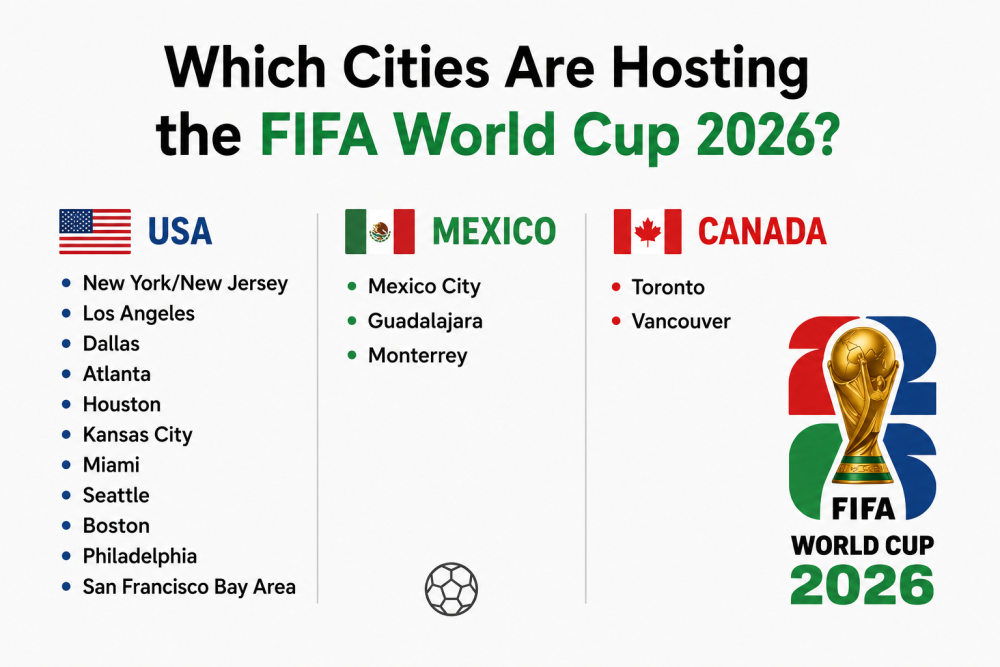
Sixteen. That's the number, and it breaks down 11-3-2.
Eleven in the United States: New York/New Jersey, Los Angeles, Dallas, Atlanta, Houston, Miami, Philadelphia, Boston, Seattle, San Francisco Bay Area, Kansas City. Three in Mexico: Mexico City, Guadalajara, Monterrey. Two in Canada: Toronto, Vancouver.
You could stop reading now and win the pub quiz. But the list hides all the interesting stuff. Which city got the final. Why "Boston" is a lie your ticket tells you. Where the semis are. Which stadium has an actual mountain in its sightline. And the one city I keep telling people to visit that nobody plans around. So stick with me for a few minutes.
Start in Mexico, Because the Tournament Did
June 11, Estadio Azteca, Mexico City. That was the opener, and the Azteca collected a record nobody else can touch now: three World Cups in one building. 1970, 1986, 2026. Pele won his last title there. Maradona scored the Hand of God and the goal of the century there, same afternoon, four minutes apart, which remains the most cinematic thing football has ever done.
The place sits at 2,200 meters of altitude. Visiting players start complaining about the thin air roughly at baggage claim. Doesn't matter. Some buildings are bigger than their flaws.
Guadalajara plays at Estadio Akron, Chivas' home ground. Tequila country is an hour down the road, the mariachi tradition was born nearby, and the city treats football the way other places treat religion, so, a proper host.
Then Monterrey, and here's my hill: Estadio BBVA might be the best-looking venue of all sixteen. One end of the stadium opens toward the Cerro de la Silla mountain, so every TV wide shot looks like concept art. Industrial city, northern Mexico, close enough to Texas that fans drove across. Remember Monterrey. I'll come back to it.
Canada's Two, and a First
Canada had never hosted a men's World Cup match before June 12, 2026. Toronto's BMO Field ended that wait, expanded for the occasion, sitting right on the lake. The city itself is home to communities from basically everywhere, which turned random group games into somebody's home fixture every single time.
Vancouver takes the west with BC Place, retractable roof, mountains one direction, ocean the other. Thirteen matches split between the two Canadian cities, and by all accounts the noise for the home side's games rearranged people's internal organs.
The American Eleven
All NFL-sized buildings, most between 65,000 and 90,000 seats. One quirk before the tour: FIFA scrubs sponsor names for the tournament. AT&T Stadium becomes "Dallas Stadium," SoFi becomes "Los Angeles Stadium," Lumen becomes "Seattle Stadium." Same concrete, cleaner tickets. I'll use the everyday names.
The final: MetLife Stadium, East Rutherford, New Jersey. July 19. Capacity north of 82,000. FIFA brands it New York New Jersey, and New Jerseyans would like everyone to check which state the building is actually in. They're right, and it changes nothing, the world will say the final was in New York.
The most matches: Dallas. AT&T Stadium in Arlington drew nine games, more than any other venue, including a semi-final under Jerry Jones' retractable roof. The other semi went to Atlanta's Mercedes-Benz Stadium, the one with the camera-shutter roof, and between the air conditioning and the sightlines it might quietly be the best pure football building in the country.
Los Angeles: SoFi Stadium, the five-billion-dollar one, which staged the US team's opener on June 12. Miami: Hard Rock Stadium, holder of a chunky knockout slate including the third-place game on July 18. Houston: NRG, roof, air conditioning, thank goodness, it's Houston in summer. Kansas City: Arrowhead, the loudest stadium in America by actual measured decibels, now applying that talent to knockout football. Lucky them. Lucky everyone there, honestly.
Coasts and the rest. Philadelphia's Lincoln Financial Field brings the Eagles crowd energy, make of that what you will. Seattle's Lumen Field has the closest thing the US has to European terrace culture. Now the two warnings, and these are the most practical sentences in this article. "Boston" plays at Gillette Stadium in Foxborough, 45 minutes from Boston on a good day, and "San Francisco" plays at Levi's Stadium in Santa Clara, which is a genuine schlep from the city. Book your hotel near the stadium's real location, not the name on the ticket. People got burned on this all group stage.
About Those Distances
Vancouver to Mexico City: nearly 4,000 kilometers. Boston to LA: a six-hour flight. Qatar 2022 famously let fans attend two matches in one day. This tournament laughs at that idea.
FIFA knew, to be fair, and regionalized the group stage into western, central, and eastern clusters so teams and fans mostly stayed in one zone for the first two weeks. But the map spans four time zones, Eastern through Pacific, and that's the entire reason a matchday stretches from noon kick-offs to near-midnight finishes on the East Coast, and why viewers in London or Dubai keep meeting 2am and 4am starts. The continent is just shaped like that.
Where I'd Actually Go
Since people ask. Final week around New York, obviously, if July hotel prices in the city don't require a second mortgage. Mexico City for atmosphere per dollar, nothing else on the list comes close, and your money doubles on arrival. Vancouver or Seattle if you want a summer holiday with football attached rather than the reverse. Kansas City for the pure American-stadium-noise experience, a knockout match in Arrowhead is a lifetime story.
And Monterrey. Told you I'd come back. Nobody builds a trip around Monterrey, and every single person I know of who went came home evangelizing about the stadium, the mountain view, and the carne asada. The sleeper pick of the whole sixteen.
The Bottom Line
Sixteen hosts, three countries, one continent-sized tournament. Mexico opened it at the Azteca, Canada made history in Toronto and Vancouver, and the United States runs the business end: Dallas and Atlanta hold the semi-finals, Miami the third-place game, and MetLife in New Jersey the final on July 19. Mind the fake city names, Boston and San Francisco especially, respect the distances, and if fate hands you a spare match ticket somewhere unexpected, take Monterrey and thank me later.
FAQs: World Cup 2026 Host Cities
How many cities are hosting the 2026 World Cup?
Sixteen, split eleven-three-two: eleven in the United States, three in Mexico, two in Canada. Both the city count and the three-country arrangement are World Cup firsts.
Which city hosts the World Cup 2026 final?
East Rutherford, New Jersey, at MetLife Stadium on July 19, 2026, branded by FIFA as New York New Jersey. Just over 82,000 seats, a river away from Manhattan, and firmly in New Jersey no matter what the branding implies.
Where were the opening matches?
Mexico City opened the tournament at the Estadio Azteca on June 11, the Azteca's third World Cup after 1970 and 1986, a record no other stadium holds. The next day Canada debuted as a host in Toronto and the US opened at SoFi Stadium in Los Angeles.
Which venue has the most matches?
AT&T Stadium in Arlington, the Dallas host site, with nine, including one semi-final. Atlanta's Mercedes-Benz Stadium stages the other semi, and Miami's Hard Rock Stadium holds the third-place match.
Why do the stadiums have different names during the World Cup?
FIFA removes sponsor branding for its tournaments, so official material says Dallas Stadium instead of AT&T Stadium, Los Angeles Stadium instead of SoFi, and so on. The buildings are the same; only the names on tickets and broadcasts change.
Are any "host cities" actually far from their stadium?
Three worth flagging. Boston's stadium is in Foxborough, about 45 minutes out. San Francisco's is in Santa Clara, a long haul from the city proper. And New York's is across the river in New Jersey. Always book accommodation around the stadium's true location rather than the city on the branding.