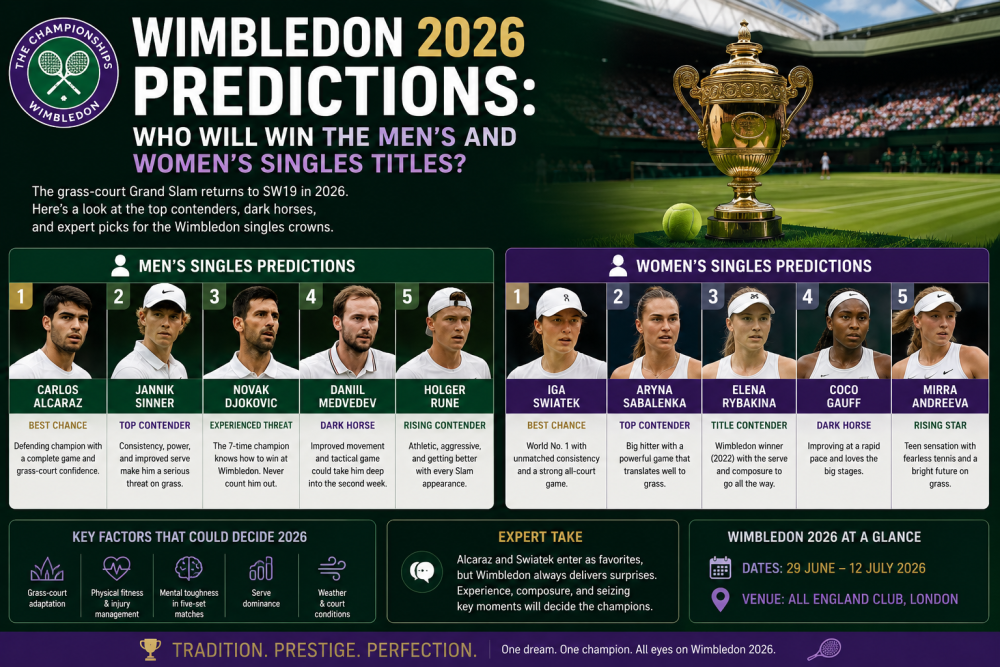
Wimbledon 2026 started June 29,, and it's already shaping up as one of the more intriguing editions of The Championships in recent memory. The story going in is almost impossibly layered: the defending men's champion Jannik Sinner going in as clear favorite, Novak Djokovic making what could be his final serious tilt at history, Carlos Alcaraz returning from injury as a wildcard factor, and a women's draw so open that almost no pre-tournament consensus exists.
Let's work through both draws properly—who's genuinely in contention, who the dark horses are, and where the decisive battles are most likely to happen.
Men's Singles: Sinner Is the Odds-On Favorite—But Nothing Is Settled
Jannik Sinner won Wimbledon in 2025, beating Alcaraz in four sets. That result was widely seen as the moment Sinner fully arrived as a grass-court force rather than just a hard-court specialist. He enters 2026 as World No. 1, priced at around -165 on the money line—which makes him the clear market favorite but not a near certainty by any means.
His game is well-suited to grass in ways it wasn't three or four years ago. The serve has become genuinely threatening rather than merely functional. His volleys have improved. And his return game, which has always been the best in men's tennis, is actually more dangerous on a surface where returns stay low and skid through.
The main vulnerability: Sinner hasn't shown the same explosive, instinctive grass-court authority that Alcaraz and Djokovic can produce at their best. He wins on grass the way he wins everywhere—through consistency and attrition—which works, but it's a style that leaves him more vulnerable to a hot player who comes out serving big and hitting flat.
Novak Djokovic: Seven Titles, and This Is His Domain
Djokovic is 39 years old. He lost at Roland Garros as the favorite when Sinner succumbed to the heat and exited early. But grass is different. Djokovic's seven Wimbledon titles tell the whole story—this is the surface that suits his style better than any other. The shorter points, the low bounce, the premium placed on serve precision and return positioning. He navigates all of that better than anyone in history.
He's priced at approximately 5/1, which reflects both his age and his form going in. The French Open was a difficult fortnight for him. But the analysts who know his game at Wimbledon specifically have noted that those extended clay-court rallies are precisely what's hardest on his body at this stage—and he won't face that on grass. When you've won as many Wimbledon titles as he has, the assumption of capability should be very high until he's actually eliminated.
Never write Djokovic off at SW19. It's something analysts keep doing and keep regretting.
Carlos Alcaraz: The Wildcard That Changes Everything
Alcaraz missed the Roland Garros 2026 final with a wrist issue but has been confirmed fit for Wimbledon. That's the game-changer. He won the 2025 Wimbledon title before losing it in the 2025 final to Sinner, meaning he knows this turf well. His grass game—the speed, the net presence, the confidence to go for winners from anywhere—is arguably the most naturally suited to this surface of any player in the field.
He's priced at around +600, which is a significant step back from Sinner but reflects genuine championship quality. If Alcaraz arrives physically right and moves through the draw without an injury scare, the final between him and Sinner is what most analysts are pencilling in. A five-set final between those two would be the best tennis the grass-court season could produce.
The risk: coming back from a wrist issue mid-season. Wrist injuries in tennis have a way of not being quite as healed as pre-tournament press conferences suggest. Watch how he's actually hitting in the first couple of rounds before drawing firm conclusions.
Alexander Zverev: The Invisible Contender
Zverev won Roland Garros 2026 and is priced around 9/1. He doesn't get talked about as a grass-court specialist—his surface wins have historically clustered on hard courts and clay—but his game has evolved considerably. The serve, always his weapon, is elite on a surface where it matters more. His movement has improved. And he arrives with momentum from Paris.
Zverev has never won Wimbledon and has been inconsistent at it. But French Open to Wimbledon form transitions happen—Rafa Nadal aside, the clay-grass shift doesn't necessarily mean a player goes backwards. If the draw gives Zverev a favorable early route, he's capable of making a semifinal.
Jack Draper: The Home Hope
Draper is probably the most interesting dark horse in the men's draw. His left-handed serve is a genuine weapon on grass that opponents cannot easily neutralize through positioning adjustments—it pulls wide in the ad court in ways that right-handers can't replicate. He reached the US Open semifinal in 2024 on hard courts, and his grass-court performances have improved significantly.
The home crowd at Wimbledon is not a trivial factor. It creates momentum, lifts tight matches, and makes Centre Court feel different than any other arena in tennis. Draper knows how to play in front of that crowd and thrives in it.
The Men's Final Prediction
The most probable final, based on draw analysis and form: Sinner versus Alcaraz. If Alcaraz is physically right, this becomes one of the most compelling Wimbledon finals in years. Sinner's consistency versus Alcaraz's explosive grass-court instinct. Five sets is the likely distance.
Final pick: Alcaraz wins his third Wimbledon title in a fifth set. The question is his wrist. If it's genuinely right, his Wimbledon game is the single strongest argument for any winner at any Grand Slam.
Women's Singles: The Most Open Draw in Years
No dominant force is striding into this Wimbledon the way Swiatek dominated Wimbledon 2025. The field is deep, several of the market leaders are in questionable form, and the draw has created some genuinely volatile sections. This is the kind of tournament where a player winning their first Grand Slam title is a realistic possibility.
Aryna Sabalenka: Favourite But Far From Certain
Sabalenka is the world No. 1 and the betting favorite at approximately 10/3. Her serve is arguably the most dominant weapon in women's tennis, and her aggressive baseline style translates well to the low-bouncing grass-court conditions. Flat hitters do well at Wimbledon, and Sabalenka is the flattest striker in the draw.
The concerns are real, though. She arrives having been bagelled twice in recent weeks, which points to a degree of mental fragility in certain match situations. Her quarter of the draw includes Mirra Andreeva, Karolina Muchova, and Naomi Osaka—all three are capable of beating her. She hasn't reached a Wimbledon final before, which suggests the surface or the atmosphere creates problems that statistics don't capture.
Her ceiling on grass is a Wimbledon title. Her floor is a quarterfinal exit to someone playing their best tennis on the day.
Iga Swiatek: Defending but Not Flying
Swiatek defends the title she won in 2025, which gave her the one Grand Slam that had been missing from her collection—grass has historically been her most challenging surface despite its absence from her major-winning record until last year.
The problem is form. She's 21-11 in matches so far in 2026, which isn't the kind of dominant preparation you want for a title defense. Her first-round opponent, Taylor Townsend, is someone who can serve big and play confident, aggressive tennis—it's a genuine opening-round danger.
If Swiatek replicates the form that won her Wimbledon in 2025, she's a title contender. The draw path through to the final is manageable. But the version of her that's struggled in 2026 would be eliminated before the second week.
Elena Rybakina: Quality When On, But Rarely On Consistently
Rybakina won Wimbledon in 2022 and has the game for it. The serve, the flat groundstrokes, the composure in big moments. On her best days she's the hardest player in the draw to beat on this surface.
The issue: she's won just one of her three grass-court matches before the tournament, and her section of the draw includes Madison Keys, Amanda Anisimova, and Linda Noskova—all awkward opponents before she'd even reach the semifinal. That's a brutal quarter even for a former champion.
Rybakina as a champion is entirely plausible. Rybakina grinding through that section of the draw without an off-day is a harder proposition.
Mirra Andreeva: The French Open Effect
Andreeva won Roland Garros in the most recent run of form and arrives at Wimbledon with momentum but limited grass-court experience. The French Open title was stunning. Backing that up immediately on a completely different surface is a different challenge. She's not a natural grass-court player in the way that pure flat hitters or big servers tend to be.
Her draw is difficult. But the confidence a first Grand Slam title provides is genuinely significant—she won't be intimidated by any situation.
Coco Gauff: The Surface Hurdle She Keeps Working On
Gauff has the athleticism and competitive mindset for deep runs at Grand Slams, and her grass-court game has improved with each passing year. The numbers still suggest she performs below her clay and hard-court level at Wimbledon, but the gap is narrower.
She'll be dangerous if she gets into the second week in form. Her biggest matches tend to produce her best tennis.
The Women's Final Prediction
The women's final is genuinely difficult to call with confidence—and that uncertainty is one of the most exciting things about this Wimbledon.
Final pick: Sabalenka wins her first Wimbledon title. Her serve and power game are tailor-made for the conditions, and she has the quality to navigate a difficult draw. The mental question mark is real, but she's won three Grand Slams already—she knows how to close it out when the level is right.
Dark horse worth watching throughout: Jessica Pegula, who has quietly improved her grass-court game and has the ability to push anyone in the field.
The Storylines Worth Watching
Serena's return. Serena Williams received a wildcard entry and faces world No. 53 Maya Joint in the opening round. She's 44 years old, hasn't played competitive singles since the 2022 US Open round of 32, and is reuniting with Venus in the women's doubles. Nobody expects her to win the title. But the crowd reaction when she walks on Centre Court will be extraordinary, and she's beaten more improbable odds more times than any player in the open era.
Djokovic's record chase. He has seven Wimbledon titles, the same number as his combined US Open and Roland Garros wins. An eighth would write another chapter in an already extraordinary story.
The prize money. The 2026 Wimbledon singles champions each receive £3.6 million — up from £3 million in 2025. That's a notable single-year increase.
The finals are scheduled for July 11 (women's) and July 12 (men's). These next two weeks will be genuinely worth watching.