The group stage is done. The round of 32 is upon us. And the World Cup—as it always does at this point—is starting to look entirely different from the tournament anyone predicted.
Norway beat France. Colombia topped their group ahead of Portugal. Morocco made it out of a group containing Brazil. Japan qualified ahead of the Netherlands on goal difference before drawing them again in the round of 32. This expanded 48-team tournament was always going to produce chaos. It's already delivering on that promise.
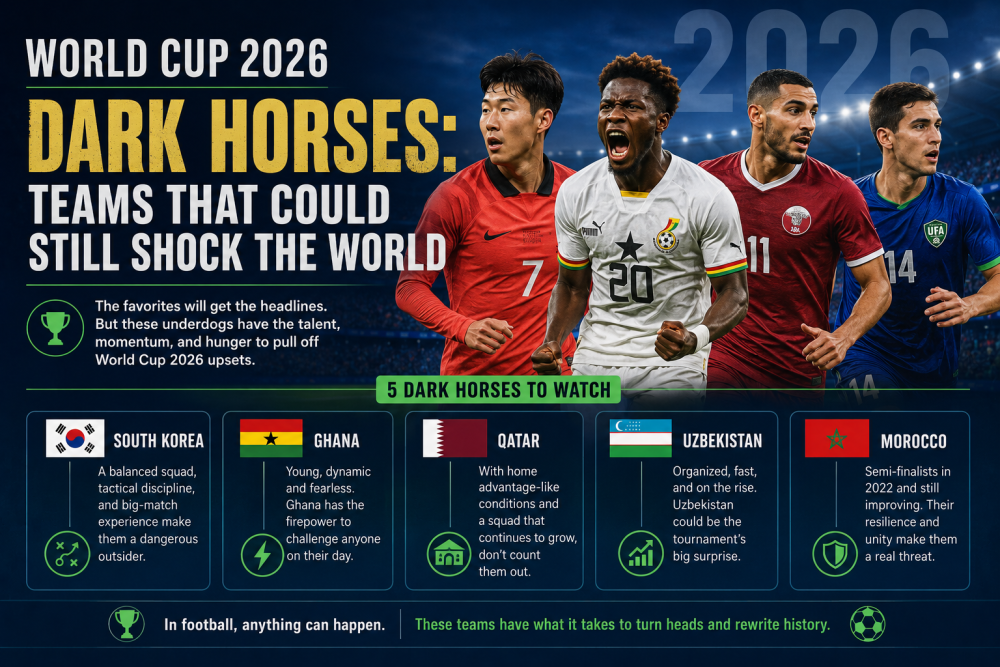
But the real question—the one every football fan loves to argue about—is which of these non-favorites can genuinely go deep. Not just survive one round, but cause real sustained damage to the heavyweights. Here's the honest case for six teams that can still shock the world.
Norway: They Already Beat France. Now what?
If there was any moment in the group stage that changed the tone of this tournament, it was Norway's 4-1 win over France on June 26. France, a team with Mbappé on four goals and a squad built to go the distance, was dismantled by a Norwegian side that had no business doing what they did.
Let's be clear about what Norway is. They came into this tournament as a proper dark horse—back at the World Cup for the first time in 28 years, with Erling Haaland as their obvious focal point and a supporting cast that most international observers underestimated badly. Martin Ødegaard organizing in midfield. Alexander Sørloth and Jørgen Strand Larsen provide depth in attack. Antonio Nusa and Oscar Bobb are capable of creating on the flanks.
What Norway showed against France wasn't a fluke built on defensive parking. They pressed high, moved the ball quickly, and used the space that France's high defensive line left behind—repeatedly. Haaland was a handful all night, as he always is, but the goals came from multiple sources. That's the sign of a genuinely dangerous team rather than a one-man threat.
Their round of 32 opponent is Ivory Coast, a team that eliminated Germany on goal difference despite losing to Ecuador in their final group game. It's a difficult game, not a gimme. But Norway going into it on the back of a historic win over France carries real weight. Their players believe they can beat anyone. After June 26, everyone watching believes it too.
Norway stormed through qualifying, routing Italy twice along the way, and dominated a European qualifying group that included several credible opponents before arriving at the World Cup with one of the most in-form squads in Europe. The bracket has been kind enough to give them a path. Whether they take it depends on sustaining the intensity that beat France, something that's harder to maintain across knockout games than it is for one electrifying night.
Morocco: The 2022 Template Is Still Alive
Morocco was the story of Qatar. Semi-finalists. The first African nation ever to reach the last four of a World Cup. Walid Regragui's team was beaten only by France in the knockout rounds, and even then it required two goals from the eventual champions to do it.
In 2026, they came in as a known quantity — which is simultaneously an advantage (experience, belief) and a potential liability (opponents have studied them). Their group stage has been impressive in what it revealed and what it confirmed. They drew Brazil 1-1 in the opener—a result that tells you everything about their defensive organization. They beat Scotland. They beat Haiti 4-2 in their final group game, with Ismael Saibari scoring his third goal of the tournament.
Saibari has been genuinely outstanding. The PSV forward's movement, his ability to receive the ball in tight spaces and finish, and his work rate without possession have made him one of the tournament's most consistently effective forwards. Achraf Hakimi remains the best right-back in the world on his best days, and he creates attacking overloads at a level few defenders can match.
Morocco sits level with Brazil in their group—the previous tournament's fourth-place team—and reached the semi-finals in 2022, meaning a deep run in 2026 would be no fluke but rather a continuation of a genuine trajectory.
Their round of 32 matchup is against the Netherlands — a legitimate heavyweight, a properly dangerous opponent, and a team that beat Japan and Sweden convincingly in the group stage. This is the exact kind of game that will tell us whether Morocco are serious contenders or simply a team that performs well until they face genuinely elite opposition. In 2022, they answered that question emphatically. The test in 2026 is whether they can do it again, against different opponents, with everyone watching.
The defensive structure under Regragui is among the best-organized in the tournament. If they keep the Netherlands out and catch them on the counter — which is their fundamental model — anything is possible.
Colombia: The Complete Team Nobody Talks About Enough
There's a version of Colombia people imagine—James Rodríguez weaving magic in a single moment of genius, the team winning or losing based on his form on a given day. That version is outdated.
Néstor Lorenzo has built something more complete. The combination of Díaz's directness, a press that suffocates in midfield, and genuine defensive solidity makes Colombia a complete side that no longer depends on one moment of James's magic to unlock games. Luis Díaz at his best — and he has been close to his best throughout qualifying and the group stage — is one of the most difficult forwards to defend against in world football. His ability to run in behind, receive in tight spaces, and beat defenders one-on-one is elite.
Colombia topped Group K. They beat Uzbekistan 3-0, beat Congo DR 1-0, and drew Portugal 0-0 in the final game. Winning your group while keeping a clean sheet against one of the tournament's more fancied sides is not nothing. Portugal rotated and wasn't trying to win, granted, but controlling that game well enough to secure first place while managing the result shows game management that Colombia hadn't always demonstrated in previous tournaments.
Their round of 32 opponents haven't been confirmed, but their position at the top of Group K sets up a favorable bracket path compared to finishing second. The Andean climate advantage that exists for South American teams — experience with heat and humidity — matters in North American summer conditions where afternoon kick-offs can be brutal.
With one of the largest followings outside of the host nations, backing they will feel throughout the tournament in US and Mexican cities, and no climate concerns whatsoever for a squad built around South American conditions, Colombia has significant structural advantages beyond their footballing quality. The home crowd dimension is real—Colombian fans travel in enormous numbers, and in cities like Miami, Houston, and Los Angeles, they'll essentially have local support. That energy matters in knockout football.
Japan: The Round of 16 Curse Has to Break Eventually
Japan has been here before. Group stage heroes, knockout stage disappointment. In 2002, they reached the round of 16 on home soil. In 2010, the same. In 2018, they led Belgium 2-0 before losing 3-2. In 2022, they beat Spain and Germany in the group stage and then lost to Croatia on penalties. The pattern is historically painful.
But the talent level in this squad and the tactical sophistication of the system, is the best Japan has produced. In 16 World Cup qualifiers, they lost only once, and they are organized, technically sound, and fearless against better opponents—the standard-bearer for Asian soccer.
In the group stage, Japan drew 2-2 with the Netherlands, beat Tunisia 4-0, and drew 1-1 with Sweden — enough to qualify as group runners-up. The 2-2 draw with the Netherlands in the opening game was the headline: Japan going toe-to-toe with a top European side and not just surviving but genuinely competing.
Now they face Brazil in the round of 32. That's the hardest possible draw for a team trying to break through. Brazil is one of the tournament's genuine contenders, and they showed in the group stage—particularly the 3-0 win over Scotland—that when Vinícius Júnior is running in behind and Matheus Cunha is finishing, they're a deeply difficult team to stop.
And yet. Japan beat Brazil in a friendly in recent years. Their organization in defense, their ability to transition quickly, and their goalkeeper Zion Suzuki's form in the tournament have given them a genuine platform. As Japan proved by beating Brazil in a friendly, they are definitely capable of reaching the quarter-finals for the first time ever, and this tournament feels like the one where they break through.
If Japan beats Brazil—and the probability isn't as low as the names on paper suggest—they wouldn't just be through to the quarter-finals for the first time in history. They'd also send a message that this isn't a tournament where names on shirts automatically determine results.
Ecuador: The Team Nobody Wants to Face in the Heat
Ecuadorians aren't flashy. They're not going to produce a highlight reel of attacking football that makes the neutral fall in love with them. What they have is something arguably more valuable in a knockout tournament: the ability to be extremely difficult to beat.
Ecuador lost just once in 19 matches during World Cup qualification, finished second behind Argentina in South America, and, under new manager Sebastián Beccacece, have become one of the most disciplined and defensive teams in the world. They keep clean sheets. They absorb pressure. And the North American summer conditions—90-degree heat in afternoon kick-offs across US and Mexican venues—affect technically superior but less physically prepared European teams far more than they affect a South American squad entirely accustomed to playing in those conditions.
In the group stage, Ecuador beat Germany in their final group game, a result that sent shockwaves through the tournament picture. Germany still progressed, but the fact that Ecuador was able to go at them and win shows the attacking threat they carry—particularly through their forwards when given space on the counter.
Their bracket path and round of 32 opponent will determine how far this talk of disruption goes. But the fundamental reality is that tournament football at this stage rewards teams that don't make mistakes and can hurt opponents on transitions. Ecuador fit that profile almost exactly.
Belgium: The Dark Horse Model Hiding in Plain Sight
Belgium has a complicated reputation at World Cups. The golden generation—De Bruyne, Lukaku, and Hazard—never quite delivered the trophy that talent deserved. The lingering sense that the best version of this squad has passed. But look more carefully at what's happening in 2026, and the picture is more interesting.
Belgium topped Group G. They drew with Egypt in the opener, drew with Iran, then destroyed New Zealand 5-1 in the final group game to secure first place. Kevin De Bruyne is still operating at a level that makes Belgium capable of dismantling any opponent on a good day. Romelu Lukaku is still finishing goals when they come to him. And crucially, the supporting cast has improved with some younger energy around the established names.
Statistical models that factor in squad strength, age profile, and group draw give Belgium high probabilities of finishing near the top of the bracket, with a clean path into the knockouts. With a field expanding to 48 squads, winning this World Cup is tougher than ever, but Belgium's profile makes them a genuine dark horse who could go deep before anyone takes them seriously.
Their round of 32 fixture is against Senegal—a challenging tie against an organized African side with individual quality across the team. If Belgium win that, the quarter-final path opens. De Bruyne in a knockout game, with a proper platform, is still one of the most dangerous combinations in world football.
Why the Expanded Format Changes Everything
Before 2026, there were 32 teams and a strict top-two-from-each-group format. The step from 32 to 48 teams, with eight additional round-of-32 places going to the best third-place finishers, fundamentally changes how dark horses operate in this tournament.
A non-favorite used to need a near-perfect group stage just to reach the knockouts. Now, a team can have a difficult group, lose one game badly, recover with two reasonable results, and still be in the tournament. The margin for error has increased. A single bad 90 minutes doesn't end your World Cup.
It also means that the teams coming through as second or third in their groups may face each other in the round of 32 before meeting the group winners in the round of 16. A dark horse that finishes third and draws another third-place finisher in the early knockout round has a genuine path to the quarter-finals without facing a major power.
That's the format change that makes 2026 different, and it's why this tournament feels particularly ripe for a deep, unexpected run from a team that wasn't anywhere near the list of pre-tournament favorites.
The knockout stage starts now. Between Norway's demolition of France, Morocco's resilience against Brazil, Colombia's tactical maturity, Japan's decade-long wait to break through, Ecuador's defensive solidity, and Belgium's quiet accumulation of results—there are at least five teams in this tournament who have genuine, evidence-based reasons to believe they can reach the final stages.
One of them will. History says so. It always happens. The question is which one.