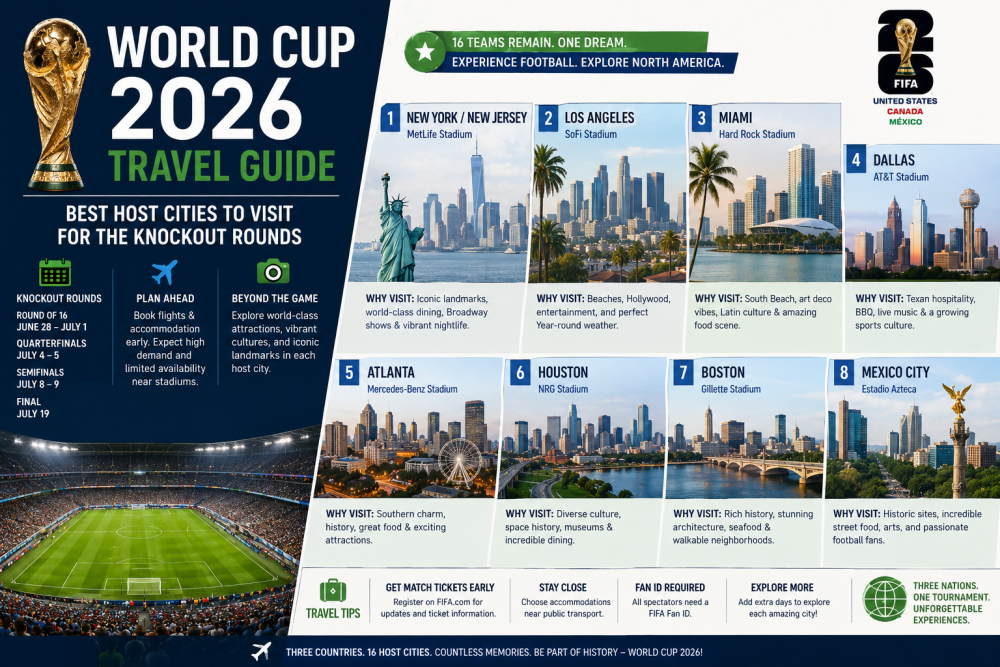
The FIFA World Cup 2026 is spread across 16 venues in 16 cities — 11 in the United States, plus venues in Mexico and Canada. If you're planning to attend the knockout rounds, you're not just choosing a match. You're choosing a city, an atmosphere, a travel experience that extends well beyond 90 minutes of football. Some of these cities are World Cup naturals. Others are genuinely surprising discoveries for international visitors seeing them for the first time.
Here's a city-by-city guide to where to spend your time and money during the knockout rounds, based on what each destination actually offers beyond the stadium.
Houston, Texas: The Quarterfinals Hub
NRG Stadium in Houston is hosting the Round of 32 match between Brazil and Japan on June 29, and the Round of 16 will see Canada face either Netherlands or Morocco here. With capacity for 72,220 and one of the most energetic World Cup atmospheres in the US, Houston is an underrated destination.
The city has the largest South American community in the United States, which means the Brazilian fan presence here is going to be extraordinary—authentic restaurants, real street atmosphere, the kind of city that knows how to host international football in a way that feels genuine rather than manufactured. Explore Montrose for restaurants, the Museum District for day-trip culture (the Menil Collection is one of the great free art museums anywhere), and the East End for Latin culture that pre-dates any tournament.
Practical notes: Houston's summer heat is serious — June and July temperatures regularly hit 95°F/35°C with humidity. Afternoon matches are demanding. Block early mornings and evenings for exploration and plan indoor activity for midday. The light rail connects downtown to NRG Stadium directly.
Dallas/Arlington, Texas: The Norway vs France Aftermath
AT&T Stadium in Arlington—yes, that one, the Cowboys' home, one of the largest stadiums in the world—hosts Ivory Coast vs. Norway on June 30 and will carry knockout matches through the quarterfinals.
Norway beating France in the group stage has made the entire Norway bracket one of the tournament's most compelling storylines. An Ivory Coast vs. Norway Round of 32 match at AT&T Stadium is already a ticket that has become extremely difficult to find.
Dallas as a base is excellent. The city is more sophisticated than its Texas-sized reputation suggests. The Bishop Arts District in Oak Cliff has independent restaurants, bars, and galleries in a walkable neighborhood. The Dallas Arts District downtown is genuinely world-class—the AT&T Performing Arts Center, the Meyerson Symphony Center, and the Dallas Museum of Art. Fort Worth is 30 minutes west and worth a half-day for the Kimbell Art Museum alone (one of the finest small museums in the country) and the Stockyards if you want the authentic Western experience.
Practical notes: Arlington itself has limited neighborhood character—it's a stadium suburb. Stay in Dallas proper (Uptown, the Design District, Deep Ellum) for access to actual city life. Uber and rideshare are essential; don't try to navigate without them.
Miami: Where the Biggest Stars Play
Hard Rock Stadium in Miami is hosting Argentina vs. Cape Verde in the Round of 32, and if Argentina progresses (which is expected), they'll face another high-profile opponent here. For a city with one of the largest Argentine communities outside Argentina, a Messi-led Argentina match in Miami is the event of the summer.
Miami is one of the most naturally suited World Cup cities in North America. The existing Latin American cultural infrastructure—the food, the music, the nightlife, the language—makes international football feel at home in a way that doesn't require creating an artificial atmosphere. Wynwood for art and restaurants. Coconut Grove for waterfront dining. Little Havana's Calle Ocho for the most authentic street atmosphere in the city. South Beach if you want the version of Miami the whole world has already seen.
Practical notes: Hotels in Miami during the knockout rounds are not cheap. Book as far in advance as possible and consider staying in Fort Lauderdale (30-40 minutes north) for significantly lower accommodation prices with easy highway access. The heat and humidity are similar to Houston's—this is summer in South Florida.
New Jersey (MetLife Stadium): The Final's Home
MetLife Stadium in East Rutherford, New Jersey — across the Hudson from Manhattan — is hosting the World Cup final on July 19, plus several knockout rounds along the way. France vs. Sweden lands at MetLife on June 30 in the Round of 32.
The practical reality: you stay in New York. Nobody stays in East Rutherford. Manhattan is a 25-minute train ride on the NJ Transit express service from Penn Station to Meadowlands, and the subway-to-train connection works well. New York in late June and July has the cultural programming that makes extended stays rewarding—outdoor concerts, Shakespeare in the Park, rooftop bars open until midnight, the High Line, Brooklyn Bridge sunrise walks, and Smorgasburg on weekend mornings.
Practical notes: New York hotel prices during the knockout rounds and especially the final week will be some of the most expensive of the year. Airbnb and apartment rentals in Brooklyn or Queens provide significantly better value than Manhattan hotels. Book immediately. The final week will be sold out well in advance.
Seattle: An Underrated Stop
Lumen Field in Seattle hosts Belgium vs. Senegal on July 1, and the city has been warmly received by international visitors throughout the group stage. Seattle is genuinely beautiful in summer—the Pacific Northwest weather that's grey and cold October through May transforms into warm, dry, perfect conditions for outdoor exploration.
Pike Place Market remains one of the great public markets in North America—actual farmers and fishmongers selling actual produce, not just tourist merchandise. The waterfront ferry to Bainbridge Island is 35 minutes and completely worth it for the views of the city skyline and the Olympic Mountains. The Seattle Art Museum is strong, and the food scene is legitimately excellent (the Pike Place Chowder, the coffee, and the seafood—all earned rather than inherited).
For European visitors, Seattle is probably the most unexpectedly pleasant World Cup city on the itinerary. The scale is manageable, the public transport usable, and the atmosphere around the tournament has been genuinely welcoming.
Mexico City: The Azteca Experience
The Estadio Azteca is hosting Mexico vs. Ecuador on June 30, and if Mexico wins (which the Mexican fans are treating as an inevitability), further knockout matches follow. The Azteca is the only stadium to have hosted two World Cup finals (1970 and 1986) and the most atmospherically charged venue at this tournament.
Mexico City itself is one of the great travel destinations in the Western Hemisphere and is routinely underestimated by North American visitors who haven't been. Polanco for restaurants and luxury hotels. Roma Norte and Condesa for neighborhood life, outdoor dining, and the streets that feel like a European city transplanted to Latin America. Coyoacán for Frida Kahlo's house museum and one of the city's best Saturday markets. The Palacio de Bellas Artes for the Diego Rivera murals that justify a visit to Mexico City on their own.
Practical notes: The altitude in Mexico City is 2,240 meters (7,349 feet). If you're not used to it, take the first day or two gently—altitude sickness is real and can significantly affect your experience. The metro is extensive and cheap but crowded; Uber or licensed taxis are the better option for most routes. Restaurant prices are considerably lower than comparable quality in the US.
Los Angeles: The Star-Studded Option
SoFi Stadium in Inglewood hosted Canada's Round of 32 win over South Africa and carries Spain vs Austria in the Round of 16 on July 2. Los Angeles is the most celebrity-friendly, most photogenic, and most geographically spread out of the World Cup cities—which means it rewards visitors who know what they want rather than those hoping to stumble onto something.
If you're going to LA for the World Cup, treat the football as one element of a wider trip. The Getty Museum for views and art. Santa Monica and Venice for beach culture. Silver Lake and Los Feliz for neighborhood restaurants without the tourism premium. Echo Park Lake for a morning walk. The Broad for contemporary art in a stunning building. Koreatown for late-night food that's genuinely excellent.
Practical notes: You need a car or a reliable rideshare budget. LA's public transport is improving but doesn't connect enough of the useful destinations to make it workable without supplements. Traffic can add 60-90 minutes to any cross-city journey in peak hours. Plan accordingly and build in buffer time.
The Practical World Cup Travel Tips
Tickets: The official FIFA ticket portal (tickets.fifa.com) is the only legitimate source. Third-party resale is legal in the US and active—StubHub, Ticketmaster, and SeatGeek all have inventory—but prices are dramatically elevated for high-profile matches. The Argentina vs. Cape Verde Round of 32 in Miami is trading at multiples of face value.
Stadium transfer logistics: Every host city has official shuttle services and fan zones. Use them. Rideshare to stadiums on match days is expensive and slow. The official transport corridors are consistently faster and better managed than they look on paper.
The fan zones: Every host city has a FIFA Fan Festival with big screens and food vendors, typically in a central public space. These are genuinely good for the atmosphere even without tickets to a match. The Brazil vs Japan match at the Houston Fan Festival on June 29 will be one of the loudest environments this side of a stadium.
Accommodation strategy for the final: Book now if you haven't. The MetLife/New York area for July 18-20 is already extremely constrained for accommodation. Consider Hoboken, Newark, or the Jersey Shore as alternative bases with NJ Transit access.
The knockout rounds run from June 28 through the final on July 19. This is the most compressed, dramatic football fortnight in four years. Getting the city right is at least half of the experience.