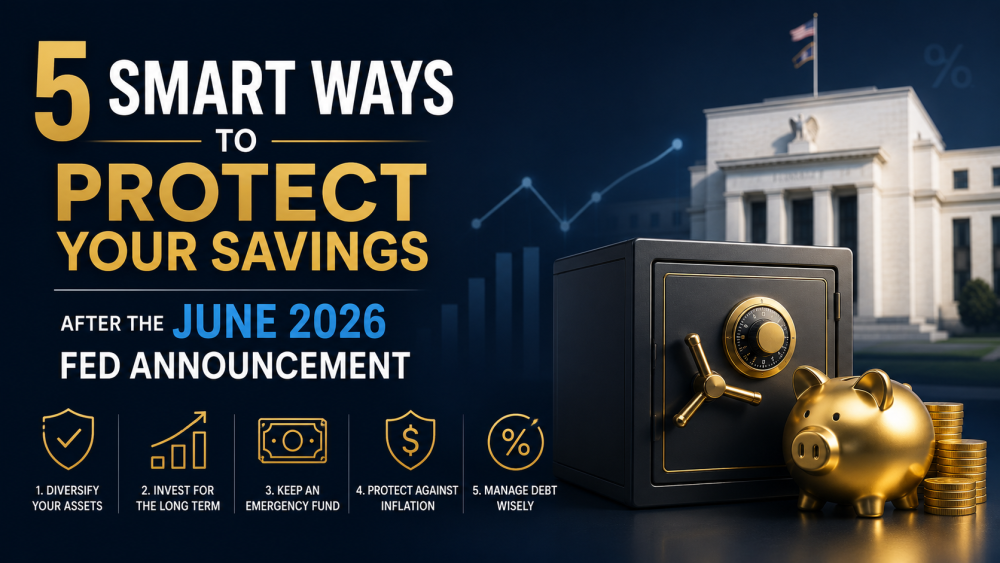
If you were watching the news on June 17th, you saw something that looked like a non-event on the surface — the Federal Reserve held rates steady, again, for the fourth meeting in a row. No change. Same 3.5% to 3.75% target range it's been sitting at since late 2025.
But here's the thing: what the Fed didn't do tells you more than what it did.
Under new Fed Chair Kevin Warsh — making his debut at the helm after replacing Jerome Powell — the FOMC quietly stripped out any language that suggested future rate cuts were on the table. The dot plot shifted. Nine of 18 officials who submitted projections now expect at least one rate hike before year-end. The median year-end rate forecast jumped from 3.4% to 3.8%. And with inflation running at 4.2% annually as of May—the highest since April 2023 and way above the Fed's 2% target—Warsh made it pretty clear that price stability is the new priority, not stimulus.
Markets got the message fast. Short-term Treasury yields climbed. Gold dipped. Traders started pricing in a potential hike as early as October. The S&P 500 slipped and the Dow wobbled, even though on paper nothing technically changed.
What's also different this time is the messenger himself. Warsh came out of his first press conference deliberately vague—almost cryptically so. He said the Fed was dropping "forward guidance," meaning don't expect the kind of hints and signals markets got used to under Powell. "I've got nothing more to say than the statement itself," he told reporters at one point. That's a significant shift, and it adds a layer of unpredictability that markets and savers alike will have to adapt to.
For everyday savers, this environment is deceptively tricky. On one hand, rates are still relatively elevated compared to where they were a few years ago, which has been decent for savings accounts and CDs. On the other hand, if inflation stays sticky and a hike does come through in the fall, the purchasing power of money sitting in the wrong places will quietly erode—and nobody sends you a letter telling you it's happening.
So what do you actually do? Here are five moves that make practical sense right now, regardless of whether the Fed hikes in October or holds again.
1. Lock In High-Yield Savings Rates Before They Disappear — or Spike
This sounds counterintuitive, but stick with me. Right now, high-yield online savings accounts are still offering solid APYs — many in the 4.5% to 5.2% range. If the Fed hikes in October, those rates could nudge up marginally. But if inflation starts to cool (which the Fed is banking on), the next move after a possible hike could be cuts—and those yields will fall.
The practical implication: if you have cash sitting in a big bank earning 0.01%, move it. Today. Not because rates are going to skyrocket from here, but because you're leaving real money on the table every single month you don't.
Think of it this way. Say you've got $30,000 sitting in a traditional checking account earning essentially nothing. At 5% APY in a high-yield savings account, that's $1,500 a year in interest — just for doing literally nothing differently. That's a car payment, a vacation, or a meaningful contribution to an emergency fund. There's no good reason not to chase that.
Just make sure you're looking at FDIC-insured institutions. A lot of the top-performing accounts right now are from online banks—Ally, Marcus, SoFi, and similar—and they're fully insured. The only real "sacrifice" is that you probably won't have a branch nearby, which most people don't care about anyway.
2. Consider Short-Duration CDs Over Long-Term Ones
Certificate of Deposit strategies are where people tend to either overthink things or completely ignore what's happening with rates. Given the current setup — where a rate hike is plausible by October but not guaranteed — locking your money into a 5-year CD right now would be a mistake.
Here's why. If Warsh and the FOMC follow through on hiking rates, longer-term CD holders won't benefit. Their rate is baked in. Meanwhile, new depositors will get better terms. You'd essentially be locked in at a lower rate while the market offers higher ones.
The smarter play right now is a CD ladder built around shorter durations — six months to one year, maybe 18 months at most. This gives you the benefit of today's still-elevated rates while keeping flexibility to roll over at potentially higher rates if a hike does materialize.
A simple ladder might look like this: split your CD budget into three or four tranches, staggering maturity dates every six months. When each tranche matures, you can reassess—either roll it over, redirect it, or just park it somewhere else depending on where rates are. It's a low-maintenance strategy that doesn't require you to predict the future, which honestly, nobody can do right now with any real confidence.
The one caveat: check early withdrawal penalties before you commit. Some banks have stiff penalties (six months of interest or more) that can wipe out the benefit entirely if you need the money early.
3. Don't Ignore Treasury Bills and Money Market Funds
There's a quiet corner of the savings world that most everyday people overlook, and that's short-term U.S. Treasuries — specifically T-bills.
Right now, 3-month and 6-month T-bills are offering yields that are competitive with, and sometimes better than, what you'll find in savings accounts. And they have a tax advantage that a lot of people don't think about: the interest is exempt from state and local taxes. If you live in a high-tax state like California or New York, that exemption makes a meaningful difference in your real, after-tax return.
You can buy T-bills directly through TreasuryDirect.gov with as little as $100. There's no cost. No middleman. You get the full yield. They're backed by the U.S. government, so credit risk is essentially a non-issue.
If you want slightly more convenience, money market funds that invest primarily in government securities (look for "government" or "Treasury" in the fund name) offer similar yields with same-day liquidity. Most brokerage accounts give you access to these, and they're a solid home for your emergency fund or short-term savings that you might need in a hurry.
One thing to watch: Warsh's tone at the June press conference was deliberately vague—he dropped what he called "forward guidance," meaning the Fed is no longer going to telegraph its moves as clearly as it used to. That increases uncertainty in financial markets, which actually tends to support demand for safe-haven assets like T-bills. If market volatility picks up later this year (and given geopolitical tensions and a possible rate hike, it might), having some cash in Treasuries gives you stability with a decent return attached.
4. Revisit Inflation-Protected Savings Options
With PCE inflation now projected at 3.6% for 2026 — significantly higher than the 2.7% forecast the Fed put out in March — the silent thief of savings is working overtime. Most people don't feel inflation directly until they're at the grocery store or renewing a lease. But it's eating into savings every single day.
One option worth revisiting is Series I Savings Bonds, commonly called I-Bonds. These are U.S. government bonds where the interest rate adjusts every six months based on the CPI. When inflation is high, the yield goes up. When it falls, the yield falls too. The current composite rate won't be life-changing, but the inflation protection element is real and meaningful for long-term savings.
The catch: there's a $10,000 annual purchase limit per person through TreasuryDirect (and an extra $5,000 if you use your tax refund to buy paper bonds). They're also illiquid for the first year, meaning you can't touch them at all. And if you redeem within five years, you forfeit three months of interest. So these are not a replacement for your emergency fund — they're better suited for the "savings I probably won't touch for at least 12-18 months" bucket.
If you have a spouse, double it. Two people in a household can buy $20,000 in I-Bonds annually. That's not a trivial amount of inflation-adjusted savings, especially over a few years of compounding.
Another approach is TIPS—Treasury Inflation-Protected Securities. These are more liquid than I-bonds (you can buy and sell them on the secondary market) and also adjust for inflation. The principal value of a TIPS bond rises with inflation as measured by the CPI, meaning both the bond's value and the interest payments you receive adjust upward when prices rise. If you're investing in a brokerage account or IRA, a TIPS fund or ETF gives you broad exposure without having to pick individual securities. Popular options include Vanguard's TIPS ETF (VTIP for short-term) and iShares' TIP fund. They're not exciting. They won't double your money. But in a world where the Fed just revised inflation expectations sharply higher, protecting purchasing power has to be part of the savings equation, not an afterthought.
It's also worth thinking about where inflation hits you specifically. If a large portion of your spending goes toward energy, food, or housing — and for most households it does — a small allocation toward inflation protection can meaningfully offset what you're losing in everyday purchasing power. That's the whole point of these instruments. They're not designed to make you rich; they're designed to keep you from quietly getting poorer.
5. Keep an Emergency Fund Fully Stocked — and Put It to Work
This is the one piece of advice that gets said so often it stops landing: keep three to six months of expenses in an accessible emergency fund. People either skip this because they think they'll be fine, or they do it and then leave the money somewhere earning almost nothing for years.
The June 2026 Fed meeting was a reminder that economic uncertainty isn't going away anytime soon. New Fed Chair Warsh has essentially said the Fed is removing its training wheels—less forward guidance, possible policy shifts, and inflation above target for the fifth straight year. The Middle East conflict is still a factor. GDP growth projections were nudged down. This is not a time to stretch financially or assume everything will stay calm.
But here's the opportunity baked into this: in this rate environment, your emergency fund doesn't have to sit idle. A properly funded emergency cushion parked in a high-yield savings account or money market fund is genuinely earning meaningful interest right now. Three to six months of expenses for a typical household might be $15,000 to $30,000. At current rates, that money is generating $750 to $1,500+ in annual interest while just sitting there ready to be used if something goes wrong.
Think of it as your safety net that's actually working for you in the meantime.
The key is accessibility. Emergency funds should not be in CDs with long lockup periods, individual stocks, or anything that could drop in value when you need the money most. The point is stability and liquidity first, yield second — but in the current environment, you don't have to sacrifice much yield at all to get that stability.
What This All Means Practically
Here's the bigger picture. The June 2026 Fed decision wasn't dramatic in terms of the rate itself—it held, as expected. But the signals underneath were significant. A new Fed chair who's deliberately less communicative, nine officials pushing for rate hikes, inflation revised upward meaningfully, and markets now pricing in a possible hike by October. The days of easy money and rock-bottom rates that pushed everyone into risk assets are long gone, and the path ahead is genuinely uncertain.
What makes this moment different from, say, 2023 or 2024, is that the uncertainty now comes from multiple directions at once. Geopolitical instability—the situation in the Middle East still has oil prices above pre-conflict levels—is feeding inflation from the supply side. Meanwhile, the labor market keeps holding up better than economists expect, which means the Fed can't justify rate cuts on employment grounds either. And now you've added a new Fed chair who has explicitly said he's not going to give markets the same hand-holding they got before. It's a more complex environment than it looks on the surface.
That doesn't mean panic. It means being intentional.
Most people's savings suffer not because of dramatic market crashes or economic crises—they suffer because of quiet inaction. Keeping money in a 0.01% account for years because switching feels like a hassle. Leaving CDs on autopilot at rates that made sense three years ago but don't anymore. Ignoring inflation protection because it sounds complicated. Forgetting to revisit the emergency fund after a major life change. These are the slow, boring ways that savings erode, and they're almost entirely preventable.
The five moves above aren't complicated. They don't require a financial advisor, though one certainly can help if your situation is more complex. They don't require you to predict what the Fed will do in October, because they're built to be flexible either way. They just require a couple of hours and a willingness to treat your savings like something worth actually managing.
Markets are currently pricing in one 25-basis-point hike by October 2026, with no further movement expected through 2027. That's actually a manageable environment if you position yourself now rather than waiting to react. The people who tend to protect their savings best aren't the ones who time the market perfectly — they're the ones who set up sensible structures, keep things diversified across a few safe buckets, and don't let inertia do the damage.
Check your accounts this week. Seriously. Look at the actual APY you're earning on every account you hold. Compare it to what's available from online banks, credit unions, or TreasuryDirect. Look at where your emergency fund is sitting and whether that cash is working for you. Review any CDs that are coming up for renewal.
If the gap between what you're earning now and what you could be earning is significant — and for most people holding money in traditional bank accounts, it absolutely is — close it. That one move alone might generate more return than anything else on this list, with zero additional risk.
The Fed gave savers a window in this rate cycle. The window may not stay open indefinitely. Make the most of it.