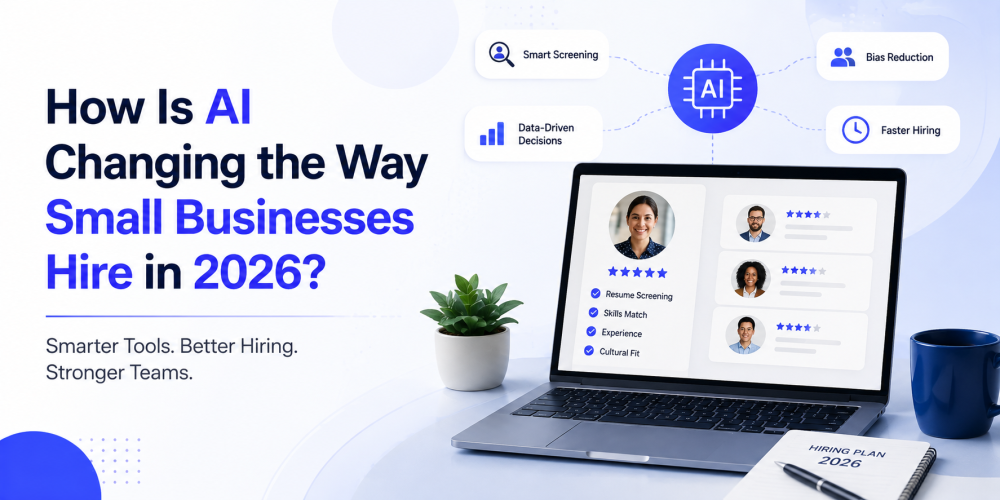
Hiring used to be the small business task most resistant to tools: too infrequent to systematize, too important to delegate, and so it ran on gut, referrals, and a Sunday evening lost to writing the job ad. AI has changed all three parts at once in 2026, and it's changed them on both sides of the table, which is the part most coverage misses: while you're using AI to write the job post and screen the pile, the candidates are using AI to write the applications filling it, and understanding that arms race is now the difference between hiring well and drowning politely.
So here's the honest map: what AI genuinely fixes in small business hiring, the screening tools' real capabilities and real legal edges, the application-flood problem and the countermoves that work, and the line, clearer than vendors admit, between what automates well and what still belongs to a human across a table. As with everything in our AI coverage, tools are described by category rather than perishable brand lists, and the standing line applies: employment law varies by country and region; hiring decisions carry legal weight everywhere; and this is general information, not legal advice. Your jurisdiction's rules and, at the right moments, a professional's eye are the authority.
What AI Genuinely Fixes: The Admin Layer
Start with the uncontroversial wins, because they're substantial. The job description, formerly the Sunday-evening casualty, is now a twenty-minute collaboration: your assistant drafts from a plain brief (the role, the real day-to-day, and the must-haves versus nice-to-haves), you correct it into honesty, and the quality actually rises. AI-drafted posts, human-edited, tend to be clearer and more complete than the copied and mutated templates most small businesses run on. The editing pass matters doubly here: generic AI job posts attract generic AI applications, and specificity, the actual tasks, the actual town, and the actual quirks of the role, is what filters before any screening happens.
Then the scheduling-and-communication layer, which is pure agent territory per our automation coverage: interview scheduling without the email tennis; acknowledgment and status messages candidates actually receive (the small-business hiring reputation problem was always silence, and it's now solvable at zero marginal effort); and the reminder machinery that stops no-shows. None of this is futuristic; it's the same when-this-happens-do-that plumbing pointed at recruitment, and for a business hiring twice a year, it converts the process from a month of background stress into a managed pipeline.
Screening: What the Tools Do, and the Lines Around Them
Resume screening is where AI promises the most and needs the most care. The capability is real: modern tools shortlist against criteria far more consistently than a tired human skimming forty PDFs at 11pm, and consistency alone removes a chunk of the arbitrariness small-business hiring was famous for. The honest limits: the tools inherit whatever biases live in their training and your criteria; they score confident pattern matches rather than potential; and a system that filters on proxy signals (school names, employment gaps, and keyword bingo) can automate historical unfairness at scale, which is exactly why regulators moved.
And moved they have; this is the section to read twice. Hiring is now among the most regulated AI use cases: several jurisdictions require disclosure when automated tools screen candidates, some mandate bias audits of the tools themselves, and the general direction of employment law, from New York's local rules to the EU's AI framework classifying hiring systems as high-risk, is unmistakable. The small-business-safe posture, wherever you are: AI proposes, a human disposes; no fully automated rejections; disclosure where your jurisdiction requires it (and increasingly, as good practice anyway); criteria written down and job-related; and a periodic sanity check of who your funnel is filtering out. That posture costs almost nothing, and it's both the fair version and the defensible one.
The Flood: When Candidates Use AI Too
Here's 2026's defining hiring problem, and every small business that's posted a role recently has felt it: Application volume has exploded because AI made applying nearly free, with one-click tailored resumes and cover letters generated per posting, and the result is more applications carrying less signal: the polished-but-identical pile. Screening harder against it with your own AI just escalates the arms race, and the businesses hiring well have mostly gone the other way: they've moved the signal somewhere AI can't cheaply follow.
The countermoves, ranked by effectiveness. Work samples over resumes: a short, paid-when-substantial, role-realistic task; the actual skill demonstrated beats any document describing it; and it's the single strongest filter available. Structured interviews: the same job-relevant questions for every candidate, scored against written criteria, which outperforms the unstructured chat on both prediction and fairness and always did; AI just made the discipline urgent. Specific applications: one or two questions only a person who read the post can answer well ("Which part of this role would you change, and why?"), cheap to add, and brutally effective at separating the clicked-apply tier. And the referral and community channels our business guides already champion, which the flood barely touches. The pattern across all four: AI devalued the documents, so the market repriced the demonstrations.
Where the Human Stays, and the Deeper Shift
The line that's held through every wave of tooling: AI compresses the funnel, and humans decide at its neck. The final interviews, the culture and judgment reads, the reference conversations, the offer—these stay human, not from sentiment but because they're the parts where the errors are expensive, unautomatable, and yours to own, the same least-privilege logic our agents' coverage applies to every delegation. A candidate rejected by a human who used AI well was treated fairly; a candidate rejected by an unreviewed pipeline is a lawsuit and, worse, possibly your best applicant.
And the deeper shift, worth naming honestly: AI is changing what small businesses hire for, not just how. As the repetitive layer of work moves to the automations covered across our AI section, the roles worth hiring humans for tilt toward judgment, relationships, and adaptability; hire for the parts machines don't do, and let the job description say so plainly. Some businesses are also, frankly, hiring slightly later and less often as automation absorbs the first assistant-shaped role; the honest framing isn't that AI replaced the hire, it's that the first hire now starts further up the value chain, which makes getting that hire right matter more, not less, and makes everything above the opposite of optional.
For the practical next step on the automation side of that equation, our guide to AI agents for small businesses walks the worth-it math and the workflows that typically come before, and sometimes instead of, the next hire.
Hiring is changing faster than any part of running a small business right now, and it's exactly the kind of shift we track weekly. If this guide sharpened your process, the Technology section of The Business Growing is where the rest of our AI-for-business playbooks live; start with the agents series and put the hour you save on your next job post toward the work sample exercise that will actually find your person.
The Bottom Line
AI is changing small business hiring in 2026 on both sides of the table: the admin layer, job posts, scheduling, and candidate communication are genuinely solved; screening tools deliver consistency worth having strictly under human review and inside the tightening legal lines; and the AI application flood has repriced the market, favoring demonstrations over documents, structured interviews over chats, and specific questions over open calls. The human keeps the neck of the funnel; the decisions, the judgment, the offer, and the roles themselves tilt toward what machines don't do.
Run it that way, AI proposes; humans dispose; the signal moved to where it can't be faked; and the smallest business hires with machinery only enterprises had five years ago, minus the enterprise's committee. The tools got cheap. The judgment stayed priceless. Hire accordingly.
FAQs: AI and Small Business Hiring
How can a small business use AI in hiring right now?
Three low-risk wins: draft job descriptions with your assistant and edit them into specificity, automate interview scheduling and candidate status messages (the silence that damages small-business reputations is now free to fix), and use AI screening only as a first-pass shortlist that a human always reviews. The admin layer automates beautifully; the decisions don't.
Is it legal to use AI to screen job applicants?
Generally yes, with conditions that vary by jurisdiction and are tightening: several places require disclosing automated screening to candidates, some mandate bias audits of the tools, and hiring systems sit in the high-risk tier of emerging AI regulation. The safe posture everywhere: no fully automated rejections, human review of AI shortlists, written job-related criteria, and disclosure as default good practice, with your local rules checked before deploying any tool.
Why am I getting so many applications that all sound the same?
Because applying became nearly free: candidates use AI to generate tailored resumes and cover letters per posting, so volume is up and per-application signal is down across every channel. The fix isn't harder AI screening; it's moving the signal: short work samples, one or two questions only genuine readers of your post can answer, and structured interviews scored against criteria.
Should I use AI video interview analysis tools?
Treat the category with heavy skepticism: tools claiming to read personality or fit from facial expressions and voice sit on the weakest science in hiring tech and the sharpest end of regulator attention. Recording interviews for note-taking and transcript summaries is useful and low-risk; automated judgment of humans on camera is neither, and small businesses lose nothing by skipping it.
Will AI replace hiring employees for small businesses?
It's shifting the sequence rather than ending it: automation absorbs the repetitive first-assistant layer, so the first hire starts further up the value chain; judgment, relationships, customer trust, and matters are more for them. The honest planning move is running the automation math before each hire, our agents' worth-it guide's arithmetic, and then hiring deliberately for exactly the work the machines can't do.
What's the best low-cost hiring stack for a small business in 2026?
For most: the AI assistant you already use (job posts, question design, and interview summaries); a scheduling automation so candidates book and get reminded without email tennis; a simple applicant-tracking layer, even a disciplined spreadsheet at low volume; and the signal-moving practices that cost nothing: work samples, structured questions, and referral asks. Category-first beats brand-chasing here as everywhere; the practices outrank every tool.