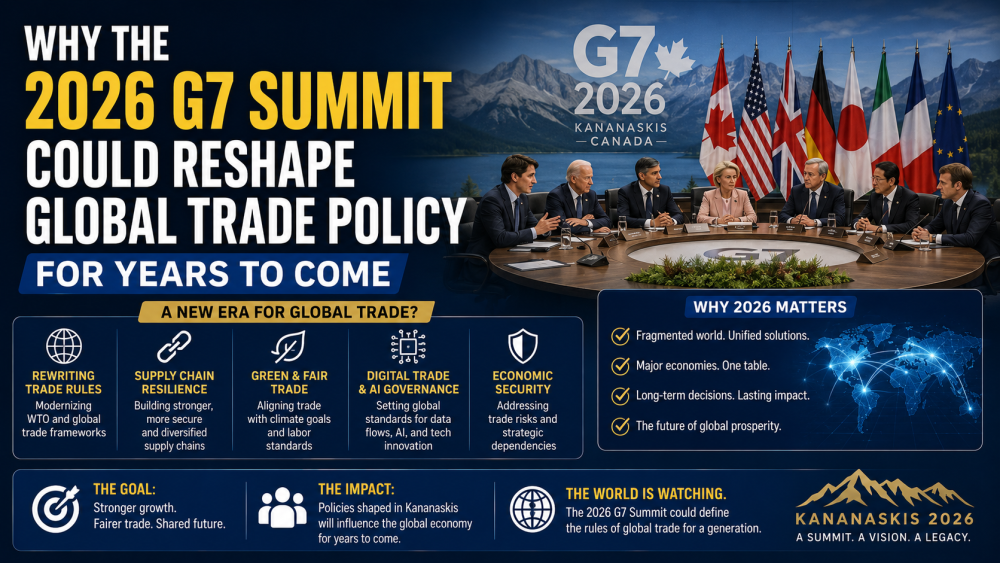
There's a temptation to treat G7 summits as expensive photo opportunities—seven leaders, a scenic location, a carefully worded communiqué that nobody reads. And honestly, sometimes that's a fair characterization. But every few years, one of these gatherings lands at a moment where the pressure is real enough and the stakes high enough that what happens in the room actually matters.
Évian-les-Bains in June 2026 was one of those moments.
The 52nd G7 Summit, held from June 15 to 17 in this small French town on the southern shore of Lake Geneva, came at a time when the architecture of global trade is under more strain than it's been in decades. US tariffs were creating uncertainty for businesses on both sides of the Atlantic. China's industrial overcapacity was flooding markets with subsidized goods in ways that were hitting manufacturing sectors from Stuttgart to Osaka. The Strait of Hormuz—a chokepoint for roughly a fifth of the world's oil—had been disrupted, scrambling energy prices and supply chain calculations simultaneously. And rare earth minerals, the unglamorous raw materials that go into everything from electric vehicles to fighter jets, had become a geopolitical flashpoint.
France, holding the G7 presidency in 2026, chose a theme that was ambitious on paper: "Forging New Partnerships and Rebuilding International Solidarity." Whether the summit delivered on that depends on what you expected walking in.
The Context: Why This Summit Felt Different
To understand why Évian mattered, you need a bit of background on how the G7 arrived at this point.
The multilateral trade system—the network of WTO rules, bilateral agreements, and established norms that has governed global commerce since the 1990s—has been fraying for years. The Trump administration's return to office accelerated that fraying significantly. The US under Trump 2.0 invoked Section 122 trade authority to impose a 15% universal surcharge on a wide range of imports, a move that created immediate friction with European and Asian allies while reshaping supply chains almost overnight.
Here's why that Section 122 authority matters to the Évian summit specifically: the 150-day clock on that authority was set to run out at 12:01 a.m. Eastern Time on July 24, 2026—just six weeks after the summit closed. The president cannot extend Section 122 unilaterally, and Congress has not passed extension legislation. So for businesses importing goods into the US, the summit wasn't just diplomatic theater—it was a potential preview of what trade policy would look like for the rest of the year. A lapse in authority could mean a sudden 15% drop in import costs overnight. Successor frameworks—or a messy void—would follow either way.
At the same time, trade fragmentation, competition over critical technologies, and fractures in the multilateral system had left the G7's role in global governance more uncertain—and more consequential—than it had been in years.
The China Question That Wasn't Quite Named
One of the more revealing aspects of how the G7 framed its agenda this year is what it chose to say indirectly.
The summit's first major economic theme was "global imbalances"—a frame covering macroeconomic divergence, industrial overcapacity, debt, underinvestment, critical minerals concentration, and the disruptive effects of AI. This is a largely veiled frame for concerns about Chinese surplus capacity and subsidized production, from steel to electric vehicles, and the strategic vulnerabilities created by the concentration of rare earth supply chains.
The G7 trade ministers, meeting in Paris in May ahead of the leaders' summit, were more explicit. They reaffirmed shared concerns regarding "non-market policies and practices" and their adverse impacts, including persistent market distortions, global structural excess capacity, harmful spillovers in global and domestic markets, and growing economic dependencies. In diplomatic language, that's a fairly pointed accusation, even if Beijing isn't mentioned by name.
What makes the Évian moment interesting is how France chose to handle China's role in these discussions. On June 11, Macron chaired a pre-summit video conference that extended beyond G7 membership to include representatives from China, India, Brazil, South Korea, and Kenya. The call focused on macroeconomic imbalances and global economic governance reform—a signal that France views the G7 not as a closed bloc but as a coordination mechanism that must engage the economies contributing to and affected by the imbalances it seeks to address.
That's a genuinely interesting diplomatic choice. You're essentially inviting the country whose industrial policies you're collectively concerned about into the conversation—partly to keep dialogue open, partly to avoid the kind of escalation that comes with pure confrontation. Macron's calculation seemed to be that the alternative—a G7 that talks about China without engaging China—creates more friction than it resolves.
The Critical Minerals Fight: Where Trade Policy Meets National Security
If there's one issue that defined the Évian summit's trade agenda more than any other, it was critical minerals.
The numbers help explain why. Europe sources all of its heavy rare earth elements, 85% of its light rare earth elements, and 98% of its rare-earth magnets from China. When export licenses tightened, magnet exports fell by three-quarters, carmakers reduced production, and Europe and the United States each faced $1.5 trillion in direct economic losses. That's not an abstraction. That's auto plants idling and electronics supply chains scrambling for alternatives.
The G7 had already begun addressing this under Canada's presidency in 2025, which produced the Critical Minerals Action Plan and created the Critical Minerals Production Alliance. But what arrived at Évian was a significantly more urgent version of that conversation. France was reportedly pushing for a permanent secretariat to steward the critical minerals agenda across presidencies—essentially institutionalizing what had previously been a year-by-year priority that could fade as presidencies rotated.
The trade ministers' communiqué from the May meeting laid out the scope of what the G7 was considering. Policy options discussed included resilience criteria; standards-based approaches; transparency and traceability mechanisms; demand- and supply-side measures such as diversification requirements, revenue stabilization mechanisms including price-gap subsidies, joint procurement instruments, and trade-related instruments such as quotas and price floors.
That's a wide toolkit. Some of those instruments—joint procurement and price floors—represent a level of coordinated economic intervention that would have seemed unlikely among G7 nations even five years ago. What's shifting is the recognition that market forces alone, under current conditions, won't produce the supply chain diversification these countries need. Government-coordinated action, once seen as distorting and protectionist, is being reframed as a defensive necessity.
Think of it this way: if a single country controls the refining of materials essential to your defense industry, your electric vehicle transition, and your consumer electronics manufacturing, the question of whether to source those materials elsewhere isn't purely an economic one. It's strategic. And the G7's evolving position is that trade policy needs to reflect that.
US Tariffs, European Tensions, and the Fragile Art of Alignment
Running alongside the minerals agenda was the thornier question of US-European trade relations.
The Trump administration's approach to trade—explicitly framed, in US Trade Representative Jamieson Greer's words, as viewing trade policy primarily as domestic policy—puts it in some tension with the multilateral spirit the G7 is ostensibly meant to represent. And yet the administration also signaled accommodation: Greer noted that the US viewed France's G7 priorities as "complementary to US efforts on trade," suggesting some genuine alignment on the China overcapacity issue even where transatlantic frictions persist.
The specific flashpoint heading into Évian was US tariffs on European vehicles. G7 trade ministers in Paris were not expected to directly address the latest US threat to impose additional tariffs on European vehicles—which tells you something about how carefully the summit's agenda was being managed to avoid outright confrontation on that particular issue. The calculation seemed to be keeping the areas of agreement (China overcapacity, critical minerals, and supply chain resilience) front and center and holding the bilateral disputes to the side.
Whether that's wise diplomacy or avoidance depends on your perspective. For businesses trying to plan across borders, though, the ambiguity is its own kind of problem. A manufacturer sourcing components from both Europe and Asia doesn't just need to know what tariffs look like today—they need some confidence about what the landscape looks like in 18 months. That kind of predictability is exactly what recent trade policy has made harder to achieve.
The Format Change: What No Joint Communiqué Actually Signals
One detail worth paying attention to: G7 leaders were expected to forgo issuing a joint communiqué for the second consecutive year. Instead of a comprehensive declaration, G7 members planned to compile area-specific outcome documents on correcting global economic imbalances and strengthening supply chains for critical minerals.
The summit ultimately produced several targeted declarations rather than a single overarching communiqué.
Some will read that as weakness—evidence that the G7 can no longer agree on enough to produce a unified statement. There's truth to that reading. A group that includes both the US under Trump and European nations with very different views on trade, climate, and multilateral institutions is going to struggle to produce consensus text.
But there's another way to read it. Area-specific documents can actually be more actionable than sprawling communiqués that try to paper over disagreement with vague language. A targeted declaration on critical mineral supply chains, for example, can be more operationally useful than a comprehensive statement that buries the same commitment under twenty paragraphs of diplomatic hedging.
What the shift in format does reveal is that the G7 is navigating genuine internal disagreement—not just between the US and Europe, but on questions about industrial policy, the role of the WTO, and how aggressively to confront China. These aren't differences that can be resolved in a three-day summit. They're managed, not solved.
The WTO Dimension: A System Under Pressure
One thread running through the Évian agenda that doesn't get enough attention is the state of the World Trade Organization.
The French presidency identified "modernizing the multilateral trade system" as one of its four core trade priorities for 2026. Earlier discussions among G7 trade ministers focused on preparing the 14th Ministerial Conference of the WTO, held in Yaoundé in March 2026. The WTO remains the nominal foundation of global trade rules, but it's been functionally weakened—its dispute resolution mechanism is still largely hobbled after the US blocked appointments to the Appellate Body, and the pace of multilateral negotiations has been glacial.
The G7 can't fix the WTO from the inside. But it can push for reforms, signal which institutions it wants to strengthen, and—perhaps most importantly—decide how much to work around existing multilateral frameworks versus through them. The direction of travel in recent years has been more around than through, with bilateral deals and plurilateral agreements picking up slack where WTO rules fall short.
The risk of that approach is fragmentation: a world of overlapping, inconsistent trade rules that adds compliance costs and uncertainty for businesses that operate across multiple markets. A mid-sized manufacturer exporting to several countries simultaneously faces a compliance puzzle that grows more complex every time a new bilateral deal creates rules that differ from existing ones.
What the Évian Summit Actually Changes—and What It Doesn't
It would be overstating things to say the 2026 G7 Summit resolved the structural tensions in global trade. It didn't. The US-EU tariff disputes remain live. China's industrial overcapacity continues. The WTO's limitations haven't been fixed. The Strait of Hormuz situation remains a variable that nobody at a summit table fully controls.
What Évian did do is establish—with more clarity than previous summits—a framework for how the G7 intends to address the China overcapacity challenge collectively rather than through uncoordinated, unilateral responses. The area-specific declarations on critical minerals and global economic imbalances, while not binding in the legal sense, create political commitments that shape what each member government can and can't do domestically without losing credibility in the room.
At a time when the global economy is threatened by geopolitical uncertainty, trade tensions, and widening imbalances, leaders are expected to demonstrate that multilateralism is essential to address today's international challenges and to ensure a stable and predictable economic environment worldwide. Whether they fully demonstrated that at Évian is debatable. But the attempt itself—in this particular political environment—is not nothing.
The setting carried its own kind of resonance. The original Group of Six convened in France in 1975 in response to oil shocks, inflation, and the collapse of the Bretton Woods monetary order. The parallels to the current moment—energy disruption, persistent inflation, and questions about the architecture of global economic governance—are difficult to overlook.
Fifty years later, the questions feel similar. The institutions trying to answer them are more strained. The economies involved are more interconnected. And the margin for getting the answers wrong is considerably smaller.
What to Watch in the Months Ahead
The summit itself is only part of the story. Several developments in the months that follow will determine whether Évian's declarations translate into meaningful policy shifts.
The Section 122 expiration in July is the most immediate pressure point. How the US handles the lapse—whether through Congressional action, Section 301 successor frameworks, or simply allowing the surcharge to disappear—will signal how seriously the administration means its G7 commitments on coordinated trade responses.
The critical minerals secretariat question will test whether France's push for a permanent institutional home for this agenda survives the transition to the US presidency in 2027. Initiatives that depend on presidential attention tend to fade when the host changes.
US-EU vehicle tariff negotiations will continue bilaterally, and how they resolve will shape the broader transatlantic trade relationship in ways the G7 format couldn't directly address.
China's response to the G7's overcapacity framework will matter too. If Beijing views the coordinated G7 approach as escalatory and retaliates with further export controls on rare earth materials, the critical minerals diversification agenda becomes both more urgent and more difficult to execute. If it sees dialogue as a viable path—as Macron's pre-summit call suggested it might—a different set of outcomes becomes possible.
The Bigger Picture
Global trade policy doesn't get reshaped at a single summit. It shifts gradually, through accumulated decisions, bilateral agreements, institutional changes, and the slow rewriting of what the major economies consider normal or acceptable. What the 2026 G7 Summit did was provide a snapshot of where that shift currently stands—and push it meaningfully forward on a few specific issues.
The turn toward coordinated responses to industrial overcapacity, the institutionalization of the critical minerals agenda, the implicit acknowledgment that trade policy and national security can no longer be treated as separate domains—these are genuine shifts in how the world's wealthiest democracies are thinking about commerce.
They're not complete shifts. They're contested, incomplete, and subject to reversal as governments change and priorities evolve. But for businesses, policymakers, and anyone trying to understand where global trade is heading over the next several years, the conversations that happened in Évian in June 2026 are worth understanding in detail—not just as diplomatic history but also as a map of the terrain ahead.
The choices being made now about supply chain architecture, tariff frameworks, and institutional coordination will be felt for years. That's not hyperbole. It's just how trade policy works: slowly, then all at once.